
This Weekend at the Folger: ‘An English Garden’
By • May 7, 2026 0 559

The Georgetown Garden Tour is Saturday, Mother’s Day is Sunday and have we got a gift idea for you: Thomas Hyll’s “The Profitable Arte of Gardening,” the first English book on the subject, initially published in 1558. Later editions had supplementary treatises on grafting and on bees — “with the rare Secretes of the honnie and waxe.”
A copy of the 1593 edition on limp vellum is being offered online for $6,000, excluding shipping.
Another option (though minus the rare Secretes) would be tickets to “An English Garden,” a Folger Consort program to be presented tomorrow, Friday, May 8, at 8 p.m.; this Saturday, May 9, at 2 and 8 p.m.; and on Mother’s Day, Sunday, May 10, at 2 p.m. A discussion at 7 p.m. will precede the two evening concerts.
The Folger in Folger Consort is of course the Folger Shakespeare Library, 201 East Capitol St. SE; consort is a 16th– and 17th-century term for an instrumental ensemble.
The instrumentalists of “An English Garden” are treble viol player Mary Springfels, who curated the program; tenor viol players Lawrence Lipnik and Mark Rimple, who doubles on lute; and bass viol player Robert Eisenstein, co-founder and co-artistic director with Christopher Kendall of Folger Consort, the library’s early music ensemble-in-residence.
“Violist” is avoided in identifying viol players since that’s what viola players are called. The alternative label “gambist” comes from the instrument’s full name: viola da gamba, Italian for “viola of the leg,” as opposed to the more familiar viola and violin, which are “of the arm.”
The violin family, the members of which have four strings, crowded out the viol family, the members of which typically have six, beginning in the 18th century, as the Baroque period (Vivaldi, Handel, Bach) gave way to the Classical (Haydn, Mozart, early Beethoven).
Viols reemerged as part of the early music and period instrument revival of the 20th century. Generally understood to have a cutoff date of 1800, the term “early music” is sometimes replaced by the more flexible “historically informed performance,” allowing for a variety of interpretations on original, replica and modern instruments.
Founded in 1977, Folger Consort will mark its 50th anniversary next year. Eisenstein, who taught music history at Mount Holyoke College in Massachusetts, is the former director of the Five College Early Music Program. Kendall, a lutenist, served as director of the University of Maryland School of Music and dean of the University of Michigan School of Music, Theatre & Dance. Bypassing a few centuries, he founded and conducts the 21st Century Consort, which performs at the Hirshhorn Museum.
Also appearing this weekend will be soprano Emily Noël and actor Holly Twyford. As narrator, Twyford will read from “The Countess of Pembroke’s Arcadia” by Philip Sidney, “The Shepheardes Calender” and “The Faerie Queene” by Edmund Spenser and “A Midsummer Night’s Dream” by the Folger’s main man.
Noël, a Washington, D.C., native, earned her bachelor of music degree from the University of Maryland and her master of music degree from Johns Hopkins University’s Peabody Conservatory. Affiliated with Denison University, where she oversees the Denison Opera Ensemble, she will direct a production of Gluck’s “Orphée et Eurydice” in Villefranche-de-Rouergue, France, this summer.
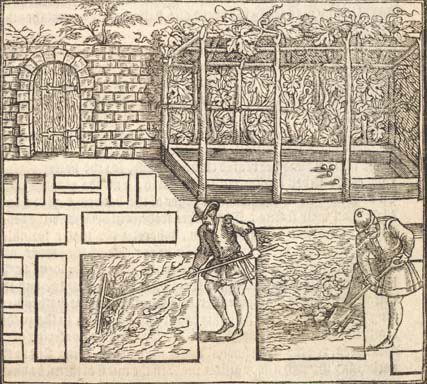
An illustration from the 1594 edition of “The Gardeners Labyrinth.” Courtesy University of Glasgow Library.
During the 2025-26 theater season, Twyford — well known to D.C. audiences and a four-time Helen Hayes Award winner — played Gen. Matilda B. Cartwright in “Guys and Dolls” at Shakespeare Theatre Company and multiple characters in “Inherit the Wind” at Arena Stage.
Inexplicably to some, Shakespeare’s plays and poems give evidence of his mastery of diverse fields of knowledge, horticulture included. There are said to be 175 plants mentioned in his plays; the Shakespeare Garden at the Brooklyn Botanic Garden, which dates to 1925, displays more than 80.
The Bard of Avon was a genius, but he may have also been swept up in what Springfels’s program notes call the “Tudor gardening craze … supported by no less than nineteen horticultural books published between 1558 [the one cited above] and 1608.”
“English Renaissance gardens were fascinating places, balancing natural beauty with artifice,” says Springfels. Further: “Music was an essential ingredient in creating a charmed atmosphere. Musicians performed while perched in triumphal arches or in the bowels of mechanical dolphins.”
Among the featured pieces in “An English Garden” are songs by Renaissance master William Byrd and by lutenist-composers Francis Cutting (“The woods so wild”) and John Dowland (“O sweet woods”); courtly dances by Anthony Holborne; “Hugh Ashton’s Masque”; and Cambridge graduate Edward Johnson’s tribute to Elizabeth I, “Eliza Is the Fairest Queen,” which includes the lyrics: “Eliza’s breast is that fair hill/Where virtue dwells, and sacred skill.” (Yes, Virginia, the Commonwealth is named for Her Royal Chasteness.)
Another of the interspersed readings will be from a letter describing the Italian Renaissance-inspired gardens at Kenilworth Castle, southeast of Birmingham, the seat of statesman Robert Dudley, 1st Earl of Leicester, where QEI spent 19 days being entertained by her “favourite” in July of 1575.
“Restorative walks and political intrigue seemed to go hand-in-hand in the arbors and galleries of stately country mansions,” comments Springfels.
Something to bear in mind on Saturday’s Georgetown Garden Tour, perhaps.