
‘Orpheus’ Concert, Embassy Art at Bloomberg Center
By • May 21, 2026 0 810

Orfeo, Orphée, Orpheus.
The mythical musician, poet and prophet who descends into Hades to rescue his beloved Eurydice has long inspired writers, painters, sculptors, composers and choreographers, whether they translate his name from ancient Greek into Italian, French, English or another language.
Spoiler: Eurydice doesn’t make it out and the lyre-plucking son of the Muse Calliope is later torn to pieces by Dionysus-crazed women.
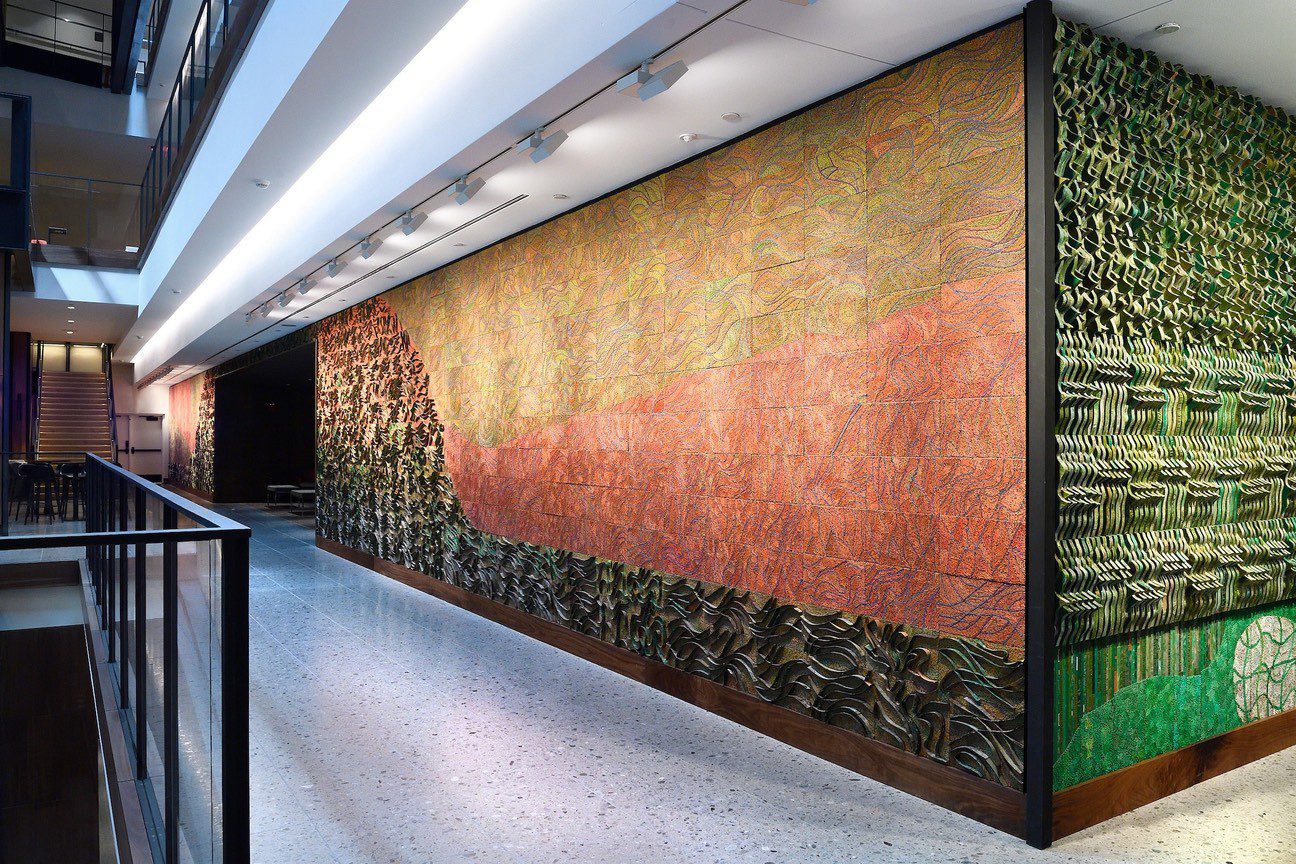
“Roots,” 2023 (installation view). Elias Sime. Photo by Will Kirk. Courtesy JHU.
For a wide-ranging encounter with the Bard of Thracia’s musical legacy, descend into the Bloomberg Center’s 375-seat theater next Tuesday, May 26, for PostClassical Ensemble’s season-closing concert, “Orpheus: The Magic of the Arts.”
During the program, guest-curated by Dorothy Kosinski, director emerita of the Phillips Collection, Ángel Gil-Ordóñez, the innovative chamber orchestra’s co-founder and music director, will conduct a 26-member ensemble. As usual, there will be a visual layer: projected images of works by, among others, sculptors Auguste Rodin and Isamu Noguchi, painters Jean-Baptiste-Camille Corot and Gustave Moreau and photographers Paul Nadar and George Platt Lynes.
The concert will open with “Che farò senza Euridice? (What will I do without Eurydice?)” from Christoph Willibald Gluck’s 1774 opera “Orfeo ed Euridice,” sung by Haitian American mezzo-soprano Jade Etienne, a recent master’s graduate of JHU’s Peabody Conservatory. Etienne will also sing part of “Der Abschied (The Farewell),” the wrenching finale of Gustav Mahler’s “Das Lied von der Erde (The Song of the Earth)” of 1908- 9, which, in Kosinski’s words, “transforms grief and trauma into paeans to nature, songs of praise of the wonders of creation.”
Other Orpheus-linked musical excerpts: the can-can-like “Galop infernal” from the overture to Jacques Offenbach’s 1858 comic opera “Orphée aux enfers (Orpheus in the Underworld)”; and an arrangement for chamber orchestra of the “Good Friday Music” from Richard Wagner’s 1882 opera “Parsifal.”
Stanley Staniski’s film of a new work by choreographer, dancer and actor Amber Mayberry, danced by Mayberry and Michael Burgos, will be screened. “Treading the Path” is set to the second movement of Beethoven’s Piano Concerto No. 4, associated with Orpheus’ taming of the Furies. PostClassical’s pianist Audrey Andrist will play the movement live; however, the size of the stage, smaller than that of the concert’s original venue, the Kennedy Center Terrace Theater, ruled out in-person dancing.
Later on, Andrist will perform Philip Glass’s solo piano version of the “Orphée’s Return” section of his 1991 chamber opera “Orphée.” Glass based the work’s French libretto on the scenario of Jean Cocteau’s 1950 film “Orpheus,” the “mirror scene” of which will be screened.
The concert will close with three episodes from Igor Stravinsky’s score for George Balanchine’s 1947 “Orpheus” ballet, with sets, costumes and props by Isamu Noguchi: “Orpheus weeps for Eurydice,” “The Bacchantes attack Orpheus” and “Orpheus Apotheosis.” A discussion with Gil-Ordóñez, Kosinski, Mayberry and JHU art history professor Stephen John Campbell will follow.
The Johns Hopkins University Bloomberg Center occupies what was once the Newseum, a museum dedicated to journalism and the First Amendment which relocated to 555 Pennsylvania Ave. NW from Rosslyn, Virginia, in 2008. The massive building was acquired by JHU upon the Newseum’s closure at the end of 2019. (Like the Newseum, the Bloomberg Center displays part of the Berlin Wall, but just a chunk.)
After a four-year, $275-million reconstruction by Ennead Architects, SmithGroup and Rockwell Group, the Bloomberg Center opened in 2023 as the Baltimore-based university’s Washington, D.C., hub. The 10-story center, rated LEED Gold, houses JHU’s well-known Paul H. Nitze School of Advanced International Studies, its new School of Government and Policy and various specialized graduate programs. The facility also serves as a D.C. outpost for other Hopkins schools and units.
Topping the original seven stories with a three-level conference facility, the center’s design prioritizes natural light and stunning views of central Washington. Along with a branch of JHU’s Sheridan Libraries and a Good Company Doughnuts & Café, its notable features include a spectacular atrium — with a stepped amphitheater and glass-enclosed “hanging” classrooms — and four site-specific works of art.
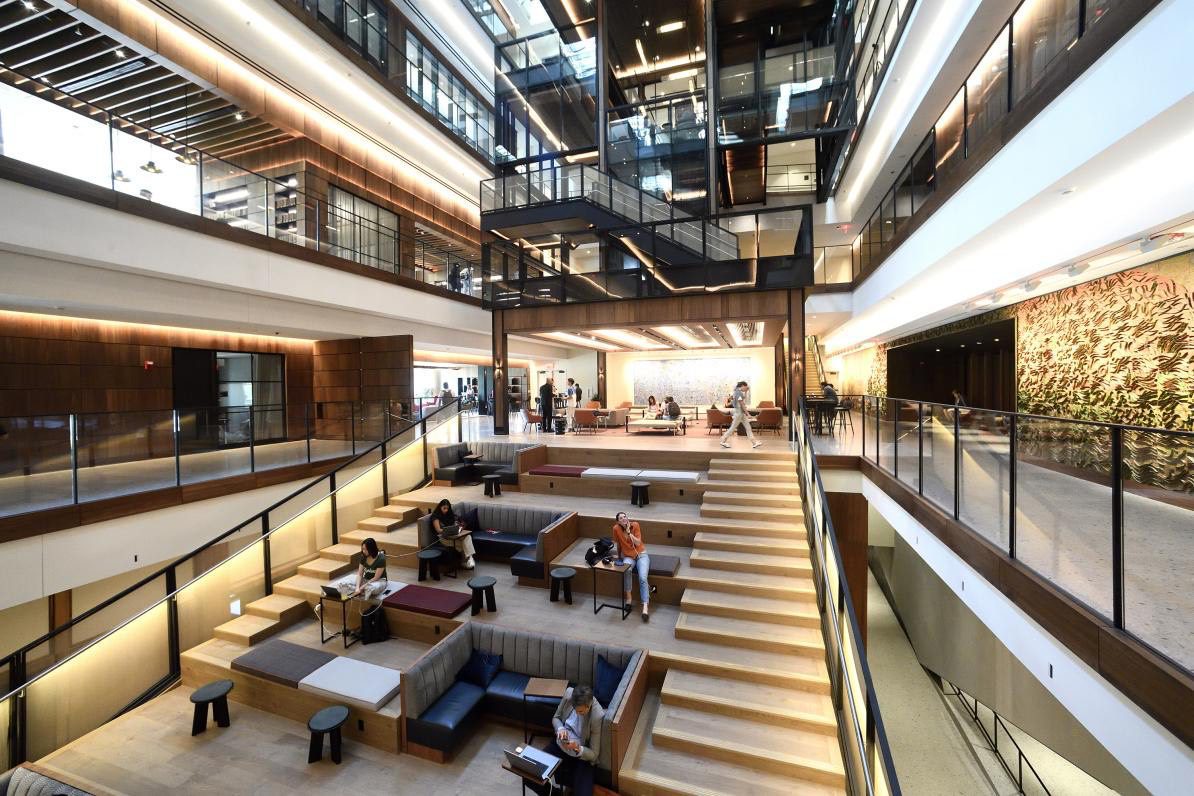
The Bloomberg Center atrium. Photo by Will Kirk. Courtesy JHU.
Only Pakistani American artist Shahzia Sikander’s marvelous glass mosaic “Metaxu” (a Greek word meaning between, in between and similarly), adjacent to the seventh-floor café, is not readily accessible to the public. The three others: Brazilian artist Sandra Cinto’s “Let Freedom Ring,” a ceramic-tile mural on the second floor that visually represents the university’s mission; Sam Gilliam’s beveled-edge mixed-media painting “A Lovely Blue And !” in the atrium; and Ethiopian artist Elias Sime’s mindbogglingly expansive and intricate “reclaimed e-waste installation,” which enwraps the theater.
More art: Through June 13, the center’s Irene and Richard Frary Gallery is presenting its fourth exhibition, “Artistic Generosity and the American Artist Abroad,” showing works by 35 artists from the collection of the Foundation for Art and Preservation in Embassies, plus related works loaned by others.
Established in 1986 by Leonore Annenberg, Wendy W. Luers and Carol Price, spouses of former U.S. ambassadors, and Lee Kimche McGrath, the founding director, FAPE since 1999 has commissioned artists to create site-specific works for new U.S. embassies in collaboration with their architects, also acquiring art to place in embassies.
Entering the gallery, one faces Martin Puryear’s maquette for “Connecting,” his 31-foot-tall knobby steel loop at the U.S. Embassy in Beijing, which opened in 2008, designed by the San Francisco office of Skidmore, Owings & Merrill (a wooden figure about six inches high indicates the actual piece’s scale). Farther on is “Model for Beijing Panels” of 2003, from Ellsworth Kelly’s project for two relief paintings, likewise commissioned for that embassy.
Behind the Puryear is a wall of photographs — including “Echoes For Marian” of 2014, Carrie Mae Weems’s black-and-white tribute to Marian Anderson’s 1939 Easter Sunday concert at the Lincoln Memorial — hung “cheek-to-cheek” to encourage viewers to make connections. The foundation, which initiated its photography collection in 2013, holds photographs by 16 artists.
Among the works from FAPE’s print collection, which began with Frank Stella’s 1989 donation of an edition of “The Symphony” large enough for a print to go to every U.S. embassy, are “Stars and Stripes at the Speed of Light” of 2000 by James Rosenquist and “Toss Up” of 2012 by Joel Shapiro. Also on view: maquettes for two of Shapiro’s signature sculptures: “Conjunction” of 1999, commissioned for the U.S. Embassy in Ottawa — FAPE’s first site-specific project — and “Now” of 2013, for the U.S. Consulate in Guangzhou.
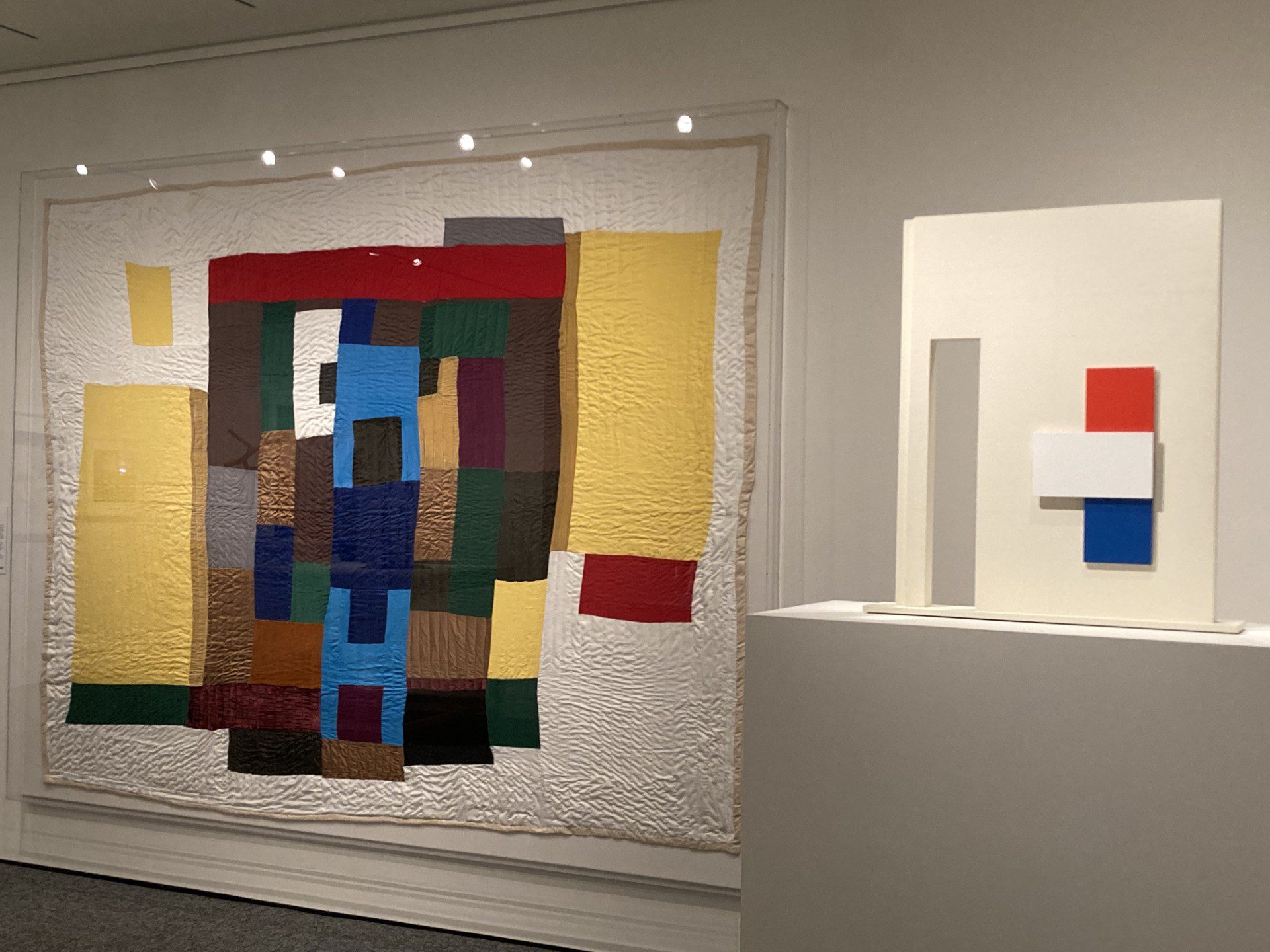
Left: “Untitled,” 2025. Avis Collins Robinson. Right: “Model for Beijing Panels,” 2003. Ellsworth Kelly. Photo by Richard Selden.
To be installed at the U.S. Embassy in Hanoi when the $1.2-billion campus, designed by the D.C.-based architecture firm Page, is completed in 2030 are Stella’s spiky white “Hanoi Star” of 2024, represented in the exhibition by a maquette (the original is at MoMA), and Avis Collins Robinson’s untitled 2025 quilt of interlocking, solid-color rectangles (the actual quilt).
From a recent addition to the U.S. Embassy in Athens are 20 of Stephen Antonakos’s 275 “Greek Travel Collages,” assemblages of objects that the artist said “found” him on trips to different parts of Greece.
“Artistic Generosity” was curated by Ellsworth Kelly Foundation President Jack Shear, a FAPE board member (and Kelly’s widower). “We are hoping to encourage dialogue about art and democracy,” noted Caitlin Berry, who became the Frary Gallery’s inaugural director in 2024.
“Arts & Democracy Events” is one of the headings for Bloomberg Center programming, nearly all of which, outside of coursework, is free. The center also hosts author talks, a Stories That Matter film series and a Sam Gilliam Lecture Series, which will present artist Coco Fusco on June 8 at 6:30 p.m.
Besides PostClassical, the theater is a venue for Washington Performing Arts’ Hayes Piano Series and performances by Peabody faculty members, students and ensembles.
Orpheus: The Magic of the Arts
PostClassical Ensemble
Tuesday, May 26, at 6:30 p.m.
Artistic Generosity and the American Artist Abroad
Irene and Richard Frary Gallery
Through June 13
Tuesday to Friday, 11 a.m. to 6 p.m.
Saturday, 11 a.m. to 5 p.m.
Johns Hopkins University Bloomberg Center
555 Pennsylvania Ave. NW