Pop — Past and Present — at the Guggenheim
By • June 25, 2026 0 670

When, someday, I visit Kansas City (which is actually in Missouri), I plan to make a beeline for Arthur Bryant’s, then stay up if I can for a 1:30 a.m. jam session at the Mutual Musicians Foundation.
Also on my KC bucket list: walking the lawns at the Nelson-Atkins Museum of Art, where four 18-foot shuttlecocks were seemingly left behind from a badminton game of the gods.
Like the typewriter eraser in the National Gallery of Art Sculpture Garden, Philly’s clothespin and paintbrush, the cherry in a spoon in Minneapolis and the downward-facing flashlight in Vegas, the Nelson-Atkins’ shuttlecocks, installed in 1994, were conceived by Claes Oldenburg and Coosje van Bruggen.
New York City, to which the Swedish-born, Chicago-raised Oldenburg moved in 1956 (he married van Bruggen in 1977), lacks one of the couple’s monuments to the ordinary. But their “Soft Shuttlecock” is on view at the Solomon R. Guggenheim Museum through Jan. 10.
Commissioned for a 1995 retrospective, the feathered monstrosity dominates the exhibition “Guggenheim Pop: 1960 to Now” like a giant albino squid, its orange head wedged in a corner. It alone — not the underwhelming “Infinity Mirrored Room – Dancing Lights That Flew Up to the Universe,” created by Yayoi Kusama in 2019 — is reason enough to pop in when you’re in New York.
The show occupies several galleries off the museum’s rotunda, currently encircled (through Aug. 2) by Carol Bove’s bent tubes of brightly painted steel, sometimes incorporating driftwood and other materials. A new body of photographic, video, text and sculptural work by Taryn Simon, like Bove in her 50s, will move into the Frank Lloyd Wright-designed helix on Sept. 18.
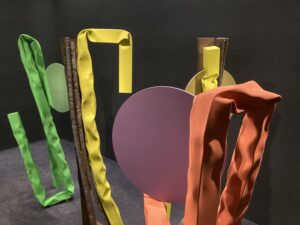
Carol Bove’s 2026 group, “Sweet Charity,” is on view off the Guggenheim’s rotunda. Photo by Richard Selden.
The first phase of “Guggenheim Pop” displays 15 pieces, mainly from the 1960s, by 11 artists: Oldenburg, van Bruggen, Richard Hamilton, Roy Lichtenstein, Andy Warhol and Chryssa on one level and Jim Dine, Oldenburg again, Lucas Samaras, John Chamberlain, Kusama and Marta Minujín on the level above.
The exhibition’s second phase, opening tomorrow, June 26, will add Pop Art-inspired works by living artists, including Maurizio Cattelan, Alex Da Corte, Shinro Ohtake, Wendy Red Star and Sheida Soleimani. (Of the initial group, only Dine, 91; Kusama, 97; and Minujín, 83, are still with us.)
Entering the gallery with Kusama’s room (accessed via a virtual and physical queue), and without the humongous shuttlecock, one meets the most impactful grouping. Next to Dine’s wall-mounted “Bedspring” of 1960 — which he found on the street, crammed with other pieces of trash and topped off with three candles — hangs Oldenburg’s “Old Freighter and Sailboat” of 1962, painted pillows clipped to a clothesline. Next to that, resting on a platform, is an untitled piece from 1962 by Samaras described as: “Faux jewel-encrusted, velvet-lined hinged leather box with painted foil interior lid, housing an antique English meat carving set with gelatin silver prints pasted on handles.” The prints are one-eyed vertical strips of a man’s face.
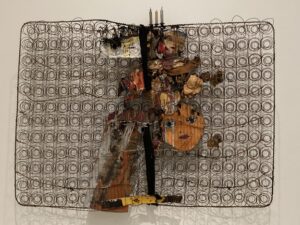
“Bedspring,” 1960. Jim Dine. Installation photo by Richard Selden.
In the shuttlecock gallery, Oldenburg is represented by his “Soft Pay-Telephone” of 1963; Lichtenstein by his “Entablature” of 1976, a stretch of classical architecture depicted in his signature painted Ben-Day dots; and Warhol by “Orange Disaster #5” of 1963, a large, two-color screenprint that reproduces a press photo of Sing Sing Prison’s electric chair 15 times (five rows of three).
Because the exhibition draws solely from the Guggenheim’s holdings, it is, as the text notes, “eclectic.” Chamberlain, Chryssa and Kusama have only tangential links to Pop. Admittedly, who belongs is a matter of opinion; some of the key figures were just passing through and others, notably Rosalyn Drexler and Marjorie Strider, were forgotten until recently.
Guggenheim curator Lawrence Alloway’s 1963 show, “Six Painters and the Object” — the six being Dine, Lichtenstein, Warhol, Jasper Johns, Robert Rauschenberg and James Rosenquist — is referenced as Pop Art’s first appearance in a New York museum. With Hamilton and Eduardo Paolozzi, Alloway had been part of the 1950s birth of British Pop Art.
The exhibition generally cited as the first in the U.S. is the Walter Hopps-curated “New Painting of Common Objects” at the Pasadena Art Museum in 1962, which featured Dine, Lichtenstein, Warhol (his “32 Campbell’s Soup Cans”), Ed Ruscha, Wayne Thiebaud and three others. Footnote: Oldenburg and Warhol were also part of an exhibition that year at Hartford’s Wadsworth Atheneum.
In New York, shows at the Judson Gallery, in the basement of Washington Square’s Judson Memorial Church, were a warm-up for the Guggenheim’s “Six Painters,” as were Allan Kaprow’s “Happenings.” A key event: Oldenburg’s “The Store,” the 1961 installation in a Lower East Side storefront of shelves displaying the artist’s painted plaster replicas of sandwiches, desserts and other items, plus a cash register (sort of, now in MoMA’s collection).
More than six decades later, as the second half of “Guggenheim Pop” is meant to demonstrate, the movement’s rebellion against abstraction and its often kitschy, occasionally political embrace of the aesthetics of comic books, advertising and our disposable society remain vital.
Speaking of comic books, the Whitney Museum of American Art will open a Lichtenstein retrospective this fall, three years after what would have been the artist’s 100th birthday. Given that other centennials are ahead — Warhol’s in 2028 and Oldenburg’s in 2029 — we are likely to keep hearing and learning about Pop Art.