
GU President Peñalver Convenes Public Dialogue on AI
By • September 14, 2026 0 269
By Francis Rienzo
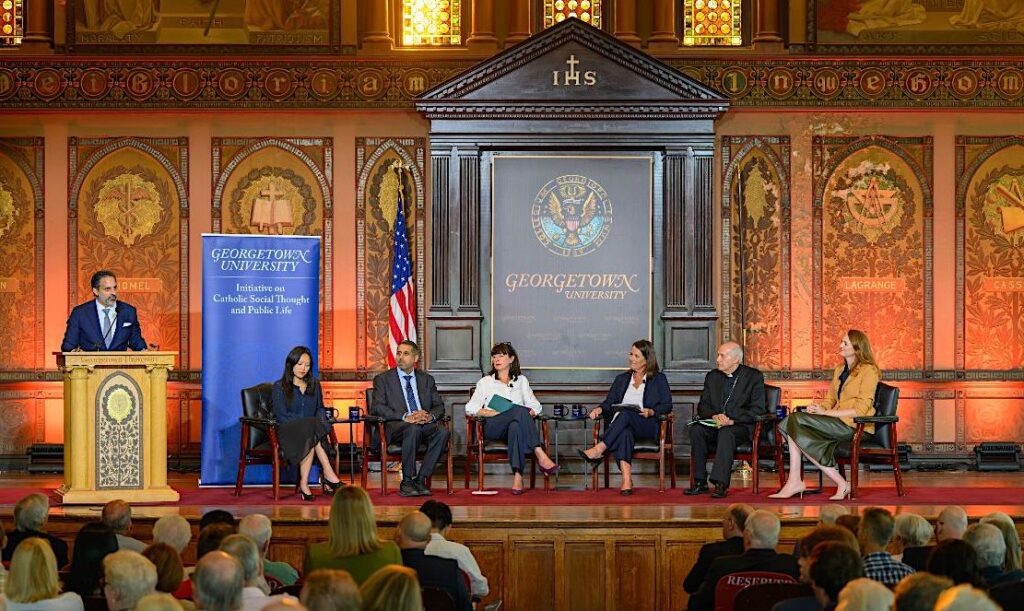
On Sept. 9, Eduardo Peñalver, the new president of Georgetown University, convened a public dialogue, “AI, Catholic Social Teaching and Pope Leo’s Invitation to Dialogue with the World,” in Gaston Hall. Kim Daniels, director of GU’s Initiative on Catholic Social Thought and Public Life, served as moderator.
The speakers included Archbishop Gabriele Caccia, Apostolic Nuncio of the Holy See to the U.S., appointed by Pope Leo, and Vilas Dhar, president of the Patrick J. McGovern Foundation, the U.S. government’s nominated expert to the Global Partnership on AI. Also participating were Molly Kinder, founding CEO of AI policy organization the Breakwater Initiative, Anna Rowlands of the University of Durham in the U.K. and Jasmine Sun, who covers AI for the Atlantic.
Opening the collaborative discussion, Peñalver emphasized the importance of Pope Leo’s encyclical “Magnifica Humanitas,” which calls us to recognize and safeguard humanity as AI advances.
Daniels began by saying that we “will consider what the development of artificial intelligence asks of the Church and the world.” Archbishop Caccia emphasized that AI needs to be “disarmed,” out of fear of autonomous weapon systems and blocks to health care and employment.
Rowlands said that the encyclical actually promotes rational conversations, rather than ones based in magical thinking, for instance, the idea that these new technologies will solve all our problems. Dhar and Sun also made this point, saying that the Church provides a grounding that Silicon Valley can use as a guiding principle: that AI governance doesn’t start from its capabilities but from the moral dignity of the person.
Sun went on to discuss the backlash against data centers and the danger of losing democracy when AI companies come to place data centers and people cannot fight back: “Very wealthy and powerful tech people in Silicon Valley are architecting the future digitally, physically, for everyone else, and folks aren’t getting a say.”
She also noted that while AI engineers will push different generative AI models to read and write, they don’t want to use them themselves, so they can preserve their own abilities. “There is some dissonance in people recognizing that this isn’t necessarily how the good life ought to be lived,” Sun said.
Kinder stated that the encyclical does not provide a policy roadmap, which is urgently needed to protect workers and jobs. “We don’t have a crystal ball,” she said, going on to speak about the threat to young people’s jobs after college “in a world where the economic incentive to hire an undergrad or recent graduate is very much weakened by AI.”
She and the other speakers emphasized the hard questions and decisions that companies will have to make regarding AI, with the Church potentially playing an essential role.