
Chef Patrick O’Connell Shares His Journey in ‘Main, Middle & Gay’
By • September 21, 2026 0 382
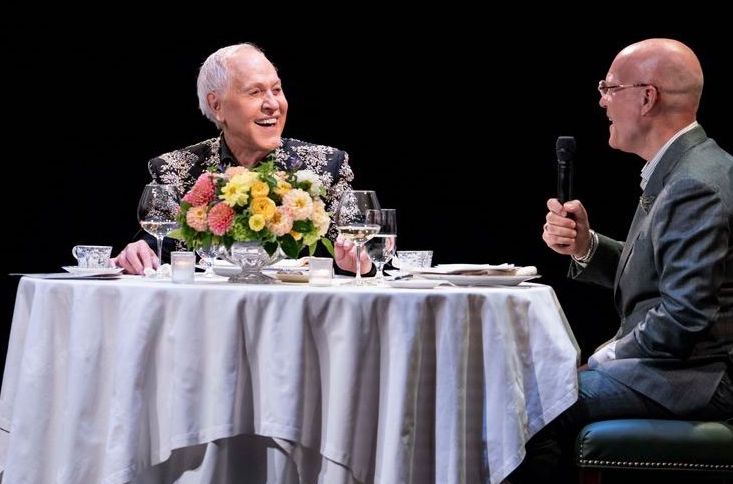
Food: it’s theater, and it’s transcendental.
Chef Patrick O’Connell’s debut memoir, “Main, Middle & Gay,” gives O’Connell the platform to speak truth to his lived experience as a break-the-mold, all-the-world’s-a-stage chef, whose energy and joie de vivre is derived from dining.
“Losing yourself in the sensual experience of dining is a high, and in many ways, parallel to what can sometimes take place during a sexual or out-of-body experience,” says O’Connell.
Whether on a physical stage discussing his book, during a spirited interview or sipping a coffee at the casual, throwback Patty O’s Café, at the multi-Michelin-starred Inn at Little Washington, O’Connell’s eyes twinkle with delight and his voice exudes enthusiasm.
His journey — from rural youth to Parisian expeditions to opening an unassuming but big-ambitioned spot in an abandoned garage and gas station in 1978 — sprints off the page in this high-octane, deeply detailed, intensely emotional memoir that took a lifetime to come together. It is a story of resilience, moxie, verve and Dalmatians.
The book was nearly never published. Over the past decade, guests (after cleaning their plates) would ask for an encore of the written variety. After O’Connell encountered a memoir consultant, he expressed misgivings about crafting such a book. After all, it might be difficult for guests, friends, family or neighbors to read.
The consultant countered that O’Connell should approach the exercise as a therapeutic one, a personal one, that doesn’t have to be published. As O’Connell slowly drafted, a guest turned out to be a New York publisher and editor. He sent the manuscript to her and she responded in just two days that wanted to publish the book.
“Many of them don’t need to be published,” she told O’Connell. “This needs to be published.” O’Connell agreed on one condition: that he could change the names of the people in the book who were still living.
Today, he said, the book is taking on a life of its own. “People have been feeling a connection that I didn’t anticipate,” he said. “All these years, they’ve only seen half the experience by being in their seats in the dining room. Now, I’ve allowed them to meet the people and see the efforts that went into creating every individual dinner every night, and gain greater appreciation for the craft of a chef.”
If the book were a film, he said with a wink, it might have echoes of “Fried Green Tomatoes,” “The Help” or “Prince of Tides.”
The media — from the local county paper to national news programs — have taken note. O’Connell’s book tour took him to the Virginia Museum of History and Culture, as well as to D.C.’s own Lisner Auditorium, where he spoke and joked onstage during an event titled “A Literary Coming Out Party” alongside restaurateur José Andrés and food writer Tom Sietsema, who, like O’Connell, is also part of the LGBTQ community.
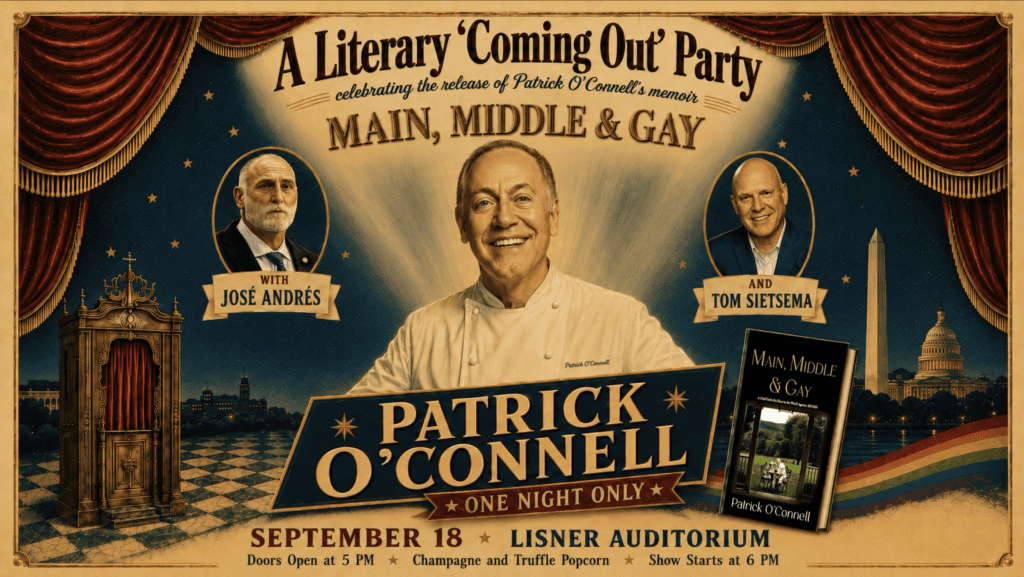
“Main, Middle & Gay” is an exploration of a life lived full of boundary-pushing imagination. It brings readers behind the scenes of O’Connell’s upbringing in rural Maryland, surrounded by tobacco fields, to youthful misadventures around the DMV and across the pond in Paris. Finally, it arrives where his fame begins, in the little Appalachian hamlet of Washington, Virginia, and the development and global success of what becomes the Inn at Little Washington.
A highly polished dining experience, the inn had humble beginnings, just like its chef and owner. O’Connell had always felt at home with restaurant staff: they were accepting people, misfits and outcasts, but open and inclusive and welcoming. Decamping to Virginia after a life-changing trip to Paris, O’Connell and his partner at the time (Reinhardt Lynch, whose name changes in the book) made the decision to open their own a restaurant in a former garage space in 1978.
When it opened, there was no commercial delivery: meaning O’Connell was an early, unwitting pioneer in the farm-to-table movement, developing deep relationships with local farmers and producers. His little spot didn’t stay little for long; just weeks after opening, a D.C. critic showered it with acclaim, calling it one of the best restaurants in the region.
Today, the Inn at Little Washington serves pioneering regional American cuisine, imbued with whimsy and French cooking technique. O’Connell’s mission is to take the simple home cooking of mothers and grandmothers, of flavor memories, and to elevate and reimagine these “to the point that they can rest side-by-side with the greatest dishes of the finest restaurants in Europe, and be distinctly American.”
O’Connell says that the book helped him realize that the inn was part of a major culinary cultural change, from canned, processed foods to creativity and global palates. It has been a “coming of age of America’s culinary consciousness, acceptance of diversity, getting over the the us/them dynamic.”
When the inn opened, he says, gay marriage was unthinkable. In this insulated crossroads in the mountains, opening the restaurant made a statement to the local population and the country, challenging stereotypes and opening the door for other LGBTQ people to be present and proud and live openly in the region. “People will accept a lot if you feed them good food,” he says.
Even at age 80, O’Connell isn’t slowing down. At the inn, he encourages his staff to work harder and think creatively, to “make ourselves a bit better every day.” Onstage at Lisner, he ended the event on the shoulders of a Lady Gaga drag queen and her dancers, a huge grin on his face, to a standing ovation of a sold-out crowd, acknowledging the impact his cooking, creativity and proud presence has had well beyond the confines of little Washington — to bigger Washington and the world beyond.

A Lady Gaga drag performer entertained the audience and author. Photo by Andrew Thomas / The Inn at Little Washington.