
Faith Is a Feast for the Senses: Shakespeare Theatre’s U.S. Premiere of ‘The Score’
By • September 24, 2026 0 252
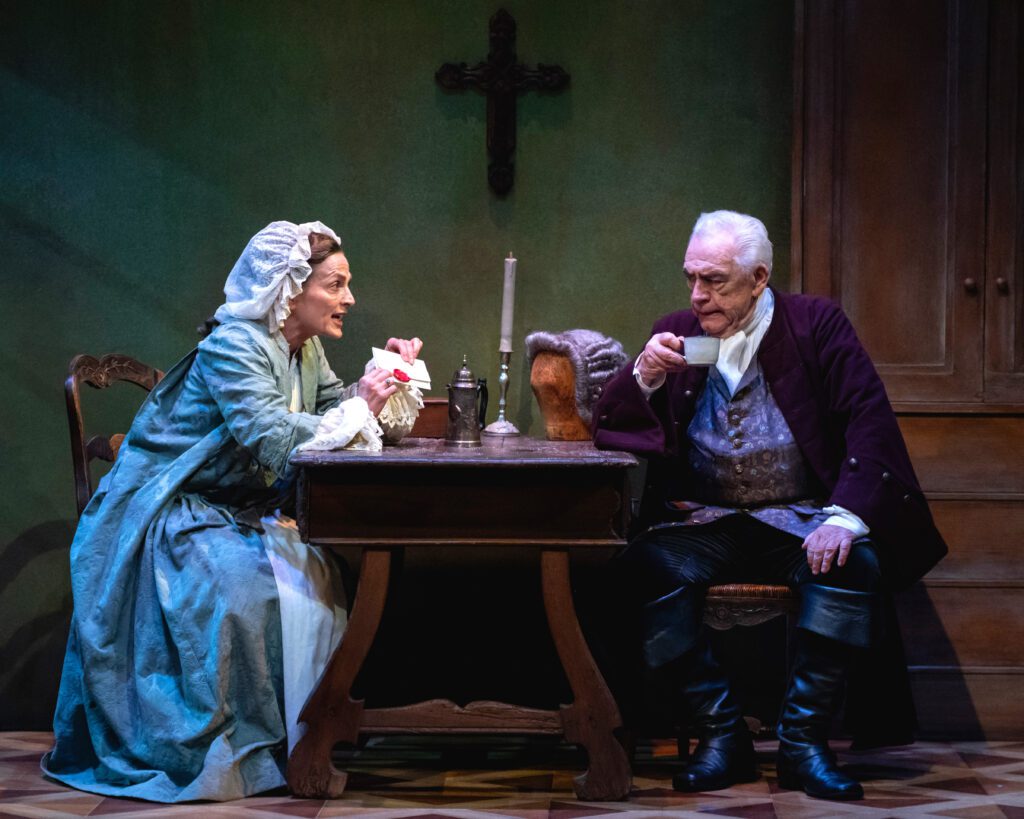
By Ryan Allen and Catherine Meale
Sir Trevor Nunn’s production of Oliver Cotton’s historical drama “The Score” brings a luxuriant, baroque touch to a propulsive play that pits genius against empire and faith against faithlessness.
The genius is provided by Johann Sebastian Bach, played by a bristly Brian Cox. Audiences who come to watch Cox deliver a performance of the tightly coiled menace that powered four seasons of the hit HBO show “Succession” and an Emmy-winning UberOne commercial will not be disappointed, but Cox and the rest of the talented cast and creative team are far from one-note wonders. Together, they create a rich milieu for the confrontation between Bach and a king bent on conquest.
Cotton’s thought-provoking script is inspired by the real-life meeting in May of 1747 between Bach and Frederick the Great, king of Prussia. This encounter would spawn one of Bach’s masterpieces, “The Musical Offering,” a collection of compositions based on a complicated musical theme the king, an enthusiastic flutist, composed himself.
In “The Score,” Bach and Frederick have music in common and not much else. Bach is a devout Lutheran. He is the esteemed Thomaskantor, in charge of composing and rehearsing the music for four churches in Leipzig, Saxony. Frederick is an avowed atheist and a proud military man, entirely unapologetic for the devastation that his troops are wreaking on Bach’s hometown and throughout Europe.
As the curtain rises, lush liturgical music swirls around us. Bach’s modest apartment is dimly lit by a single candle. This is Bach’s world in the twilight of his life. It has been a world resonant with the devout music through which Bach experiences God, but now the racket of dueling, drunken soldiers invades the room and displaces the holy sounds of Bach’s cantatas. To Bach, every drumbeat or bugle call carries with it the horrors of war.
As one might imagine, Bach is not eager to bow before the monarch who has brought violence to his streets. Regrettably, he has already accepted the king’s invitation. His wife, Anna (Nicole Ansari-Cox, Cox’s real-life wife) urges him on and instructs him, “you’ll keep your temper,” a prediction that those familiar with Cox’s work will know is bound to fail.
Fortunately for us, it does. Cox boils over with irritation, erupting with well-aimed outrage. This is the master of irascibility at his finest. But Cox’s Bach is more. He is a loving father. He is a king’s subject. (Cox memorably delivers Bach’s almost-cowed vulnerability as Frederick catches him in a nightshirt and breeches.)
Cox’s Bach is a man of deep faith struggling through a fallen world. Sometimes, that faith explodes out of him in potential life-threatening tirades. Should one shout at a monarch? Bach’s son, Carl — one of the court composers — certainly doesn’t think so. Sometimes, Cox renders this faith as pain, as when the atrocities of war cause Bach’s failing eyes to ache; he is losing sight of the mortal world and turning his gaze to the eternal.
Perhaps Bach’s belief resonates most when Cox uses the quiet professions of Bach’s conscience to turn over the central question of the play: what happens in the moment between an impulse and an action? Can divine intervention occur here? One cannot help but think “The Musical Offering” represents Bach’s attempt to extend God’s grace to Frederick, much as his liturgical music has been his attempt to extend God’s presence to the congregation.
This is a beautifully acted play. Carl Graun (Matthew Romaine), Johann Quantz (Christopher Staines) and Franz Benda (Toby Webster) amuse and delight as a trio of composers and musicians complicit in the king’s prank on “old Bach,” with an aim to stump his musical genius. Peter De Jersey shows up as Voltaire, a half-ally to Bach, fully French and impossible to ignore in a bold, humorous interpretation of the role. One of Bach’s only true allies, his talented and loyal son Carl, is given a tense, compellingly nervous edge by Jamie Wilkes. Stephen Hagan transforms Frederick II from a louche dilettante at play, almost too emptily villainous, through a bold if legalistic statesman, a military figure and, finally, into a man seeking understanding of the small voice of conscience calling him, possibly, away from conquest.
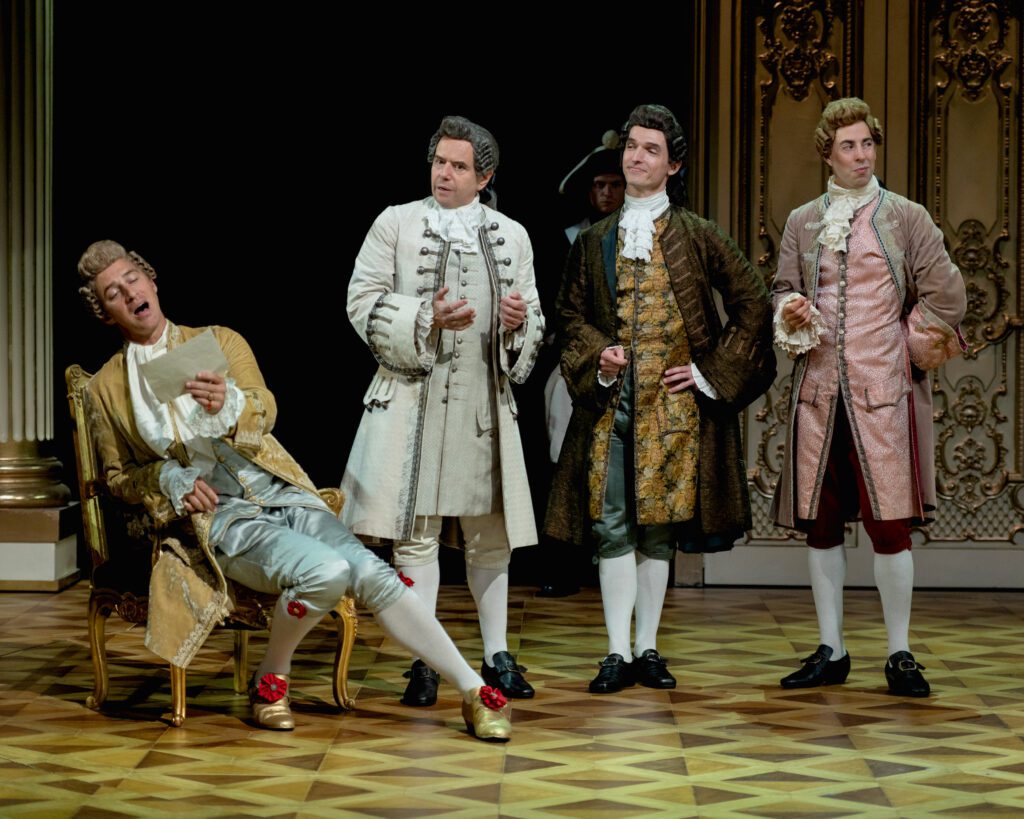
Hagan as Frederick the Great with his collection of court composers, portrayed by Staines, Webster and Graun. Photo by Teresa Castracane. Courtesy STC.
The production truly soars where the actors collaborate with the vision of the creative team. Juliet Garricks’s Emilia shines in a wordless scene, standing alone on stage bathed in warm light to capture a moment of profound faith. During scene changeovers, the set whirls on a parquet circle like dancers waltzing through a ballroom, while a focused spotlight illuminates intimate foreground action.
The costumes vividly form King Frederick’s character: first, an over-decorated dandy in a series of ornate outfits, then, finally, in a military uniform, but still himself with shiny silver epaulettes and a bright silver sash. Tying these visual elements together, Sophie Cotton’s sound design deftly blends additional compositions, recorded snatches of authentic Bach keyboard tracks and live music onstage, showcasing Bach’s works primarily through short excerpts and musical themes rather than full concert performances.
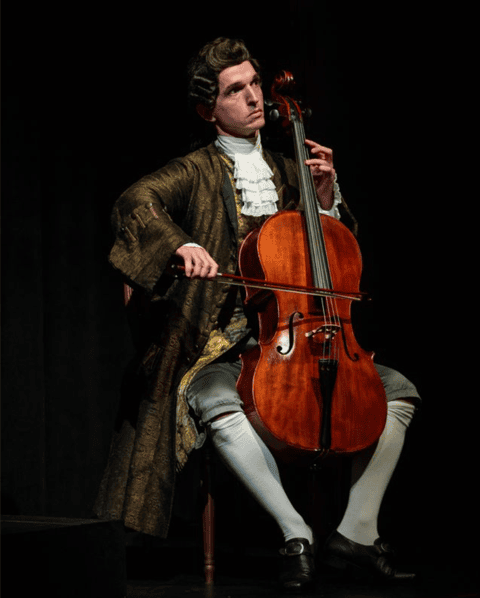
Webster’s Benda reveals a hidden talent as we are called back from intermission. Photo by Teresa Castracane. Courtesy STC.
The seasoned core creative team behind the original production at Theatre Royal Bath — including set and costume designer Robert Jones, lighting designer Johanna Town and sound designer and additional composer Sophie Cotton — has reunited for this West End transfer. Well worthy of a second mention, wielding the directorial baton is theater legend Nunn, former artistic director of the Royal Shakespeare Company for 18 years, who has directed all 27 of Shakespeare’s plays alongside the world premieres of West End and Broadway blockbusters including “Les Misérables” and Andrew Lloyd Webber’s “Cats.”
The sum of the many talents involved in this production add up to a splendid whole: a reflection on faith that delights the senses, a drama rife with laughter, a prank that may reveal something profound.
The Score
Through Oct. 25
Harman Hall, 610 F St. NW