Latino Culture at the American History Museum
By • October 1, 2026 0 204
National Hispanic Heritage Month runs from Sept. 15 to Oct. 15. Why? Because five Central American nations celebrate their independence on Sept. 15. Mexico celebrates on Sept. 16 (not on Cinco de Mayo) and Chile on Sept. 18. Also relevant: Día de la Raza, Oct. 12, the day in 1492 a certain Genoese navigator came ashore.
Launched in 1968 as a week, the designation expanded to a month during the final year of the Reagan administration.
Honoring “the stories, contributions and impact of Latinos in the United States,” the National Museum of the American Latino was established by Congress in 2020. Last month, the Smithsonian announced that NMAL would occupy the existing Arts and Industries Building, an 1881 structure next to the institution’s original building, the Castle.
As the plans for NMAL’s permanent home slowly advance, two Latino-specific exhibitions, “Corazón y vida: Lowriding Culture” and “¡Puro Ritmo! The Musical Journey of Salsa,” are on long-term view at the National Museum of American History, making it an ideal choice for a National Hispanic Heritage Month outing.
Curated by L. Stephen Velasquez of NMAH’s Division of Home and Community Life, “Corazón y vida,” meaning “heart and life,” explores a phenomenon that began in Southwestern cities in the 1940s. Mexican Americans, many of them returning veterans, acquired used cars, lowered their suspensions and decorated them inside and out. Each “lowrider” — a masculine noun in Spanish, sometimes replaced with the slang term “ranfla” — was a unique DIY creation.
Though “Corazón y vida,” on the second floor of NMAH’s west wing, is largely a show of photographs, videos and text panels, two of the artifacts on view are pristine metallic marvels.
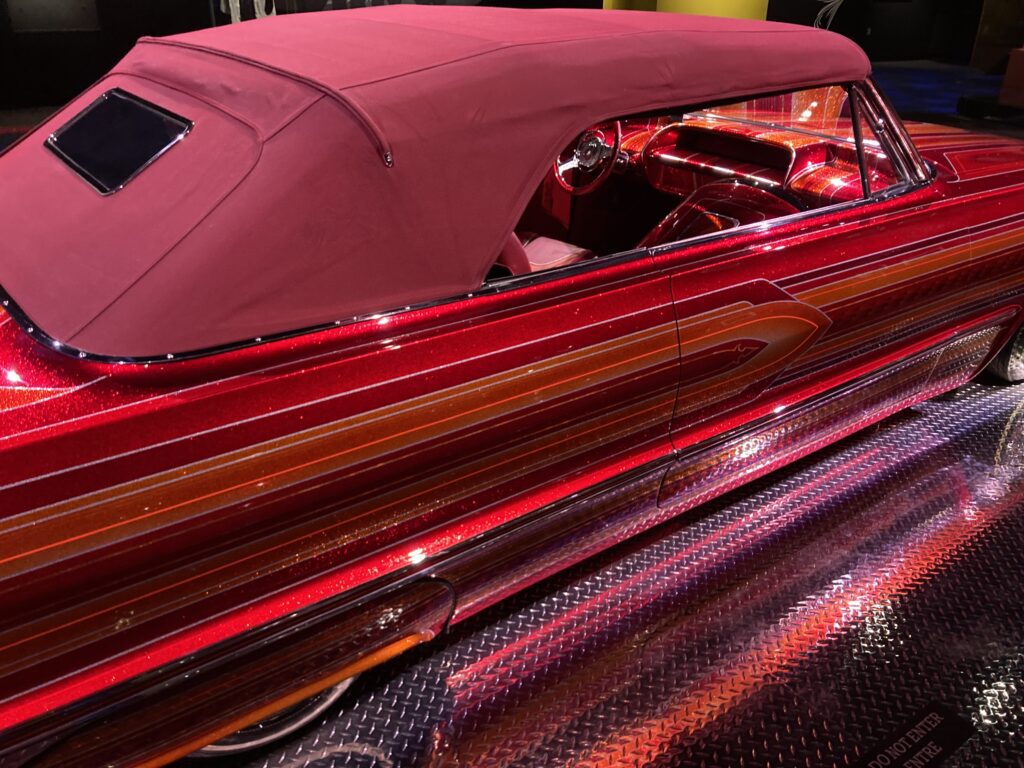
Spotlit behind barriers, bajito y suavecito (low and smooth), are: “El Rey,” a 1963 Chevy Impala Super Sport customized by three generations of the De Alba family of Vallejo, California; and a second red Super Sport, from 1964, “Gypsy Rose,” designed by Jesse Valadez, founder of the Imperials Car Club of East Los Angeles.
“El Rey” was named for Albert De Alba Sr.’s favorite mariachi song, recorded by Vicente Fernández in 1973. Partial translation: “I have no throne or queen/Nor anyone who understands me/But I’m still the king.”
Adorned with hand-painted roses and leaves, “Gypsy Rose” appeared in the title sequence of “Chico and the Man,” a mid-’70s sitcom starring Freddie Prinze. Nearby, in a 1979 photo by Ricardo Valverde titled “Gypsy Rose,” a woman with long black hair, heavy eye makeup and a hint of a smile leans against the car.
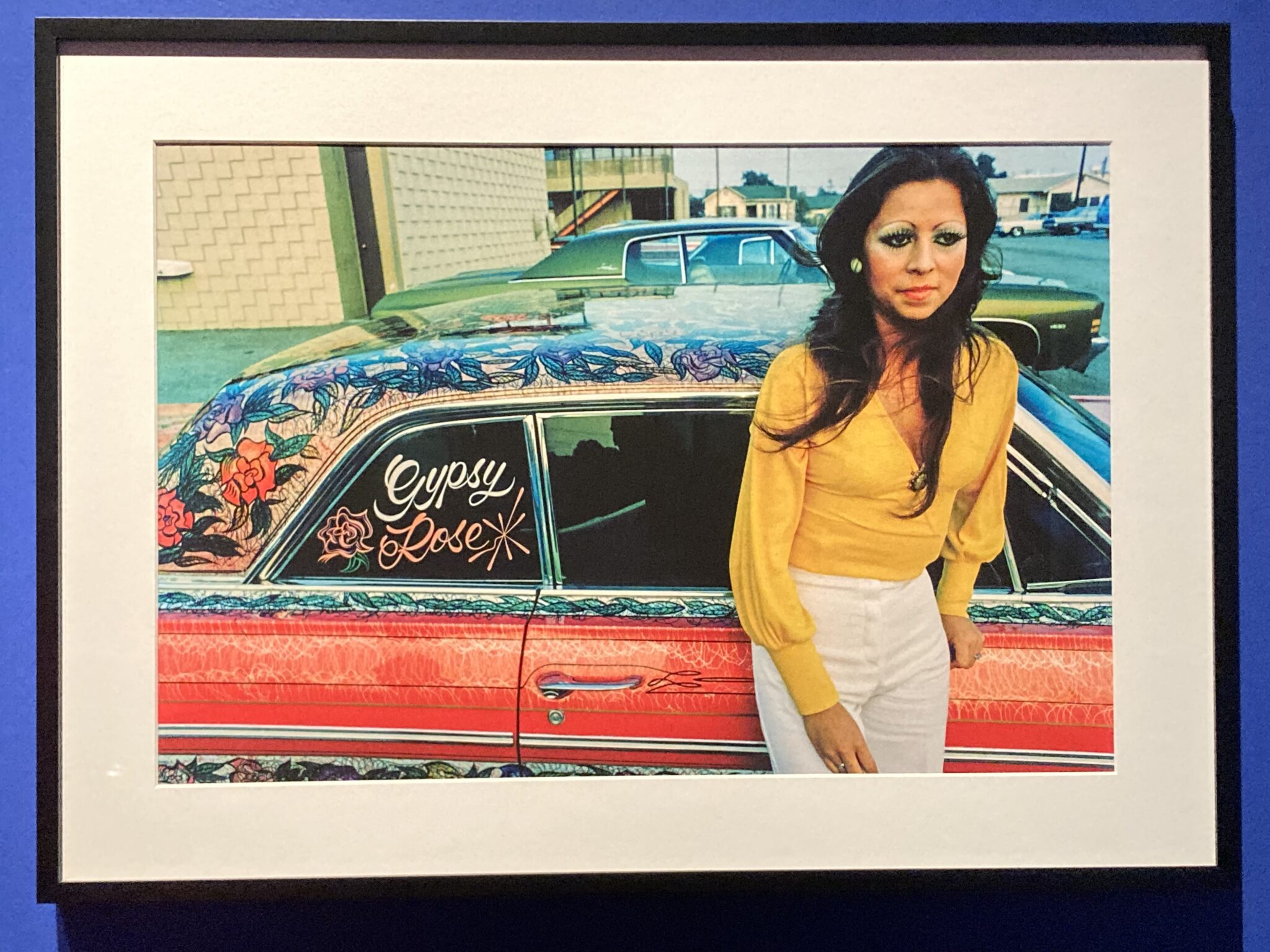
“Gypsy Rose,” 1979. Ricardo Valverde.
Next to one of the gleaming vehicles are three small panels where visitors can: “Feel the grooves of the engraved metal, the roughness of primed metal, the smoothness of painted metal and the texture of upholstery designs.”
Missing, of course, is the thrill of seeing the cars in motion — including the up-and-down moves that alterations to their suspensions made possible. At least in part, notes a Smithsonian magazine article, these mechanical enhancements may have been a response to a 1958 California law banning lowriders from public roads: “By some accounts, the hydraulic systems were less a stylistic flourish than a workaround — allowing cars to stay inches from the asphalt to show off their dancing, bouncing and hopping, and then rise at the flip of a switch when police came by.”
Other eye-catching artifacts: an engraved mirror on which the Virgin of Guadalupe hovers over a classic automobile, with mountains behind and a flower border; Avery Tovar’s souped-up Imperial TaylorTot Stroller, “modified” by her father, Daniel, “the third generation in a family of builders and painters known for building ‘bombs’ (1930s-style cars)”; and a snazzy repro zoot suit with long, dangling watch chain.
“Lowriders [the drivers] today celebrate the pachuco legacy by styling themselves in distinct zoot suits as bold as the cars they drive,” reads the text. Though its etymology is disputed, pachuco refers to the stylishly defiant Mexican American counterculture that spread from El Paso, Texas, in the late 1930s. The more familiar term Chicano, likely a shortened form of Mexicano, is said to have been a slur, “reclaimed” in the 1960s by Mexican Americans seeking to strengthen their group identity and fight discrimination.
To visit the Molino Family Latino Gallery — NMAL’s temporary home at the American History Museum — make a right at the 1831 John Bull locomotive parked at the first-floor entrance to NMAH’s east wing. A large screen welcomes you to “¡Puro Ritmo! The Musical Journey of Salsa.” The audiovisually rich exhibition’s lead curator was Ranald Woodaman, the Latino Museum’s assistant director of exhibition development.
Past a Salsa’s Roots case on the left — displaying a pair of claves (wooden rods that add a rhythmic “knock”), Cuban maracas (for the “shaking rice” sound) and a güiro (a ridged gourd scratched with a stick) — one enters a central space in which tall video kiosks invite visitors to “Dance Salsa with Edwin Sorto,” “Learn Timba with Aymee Nuviola,” “Discover Bomba with Sheila Osorio” and “Learn Percussion with Sheila E.” The two sets of four kiosks border the viewing area for a slide show and short videos of musical performances. There are also listening stations here and elsewhere.
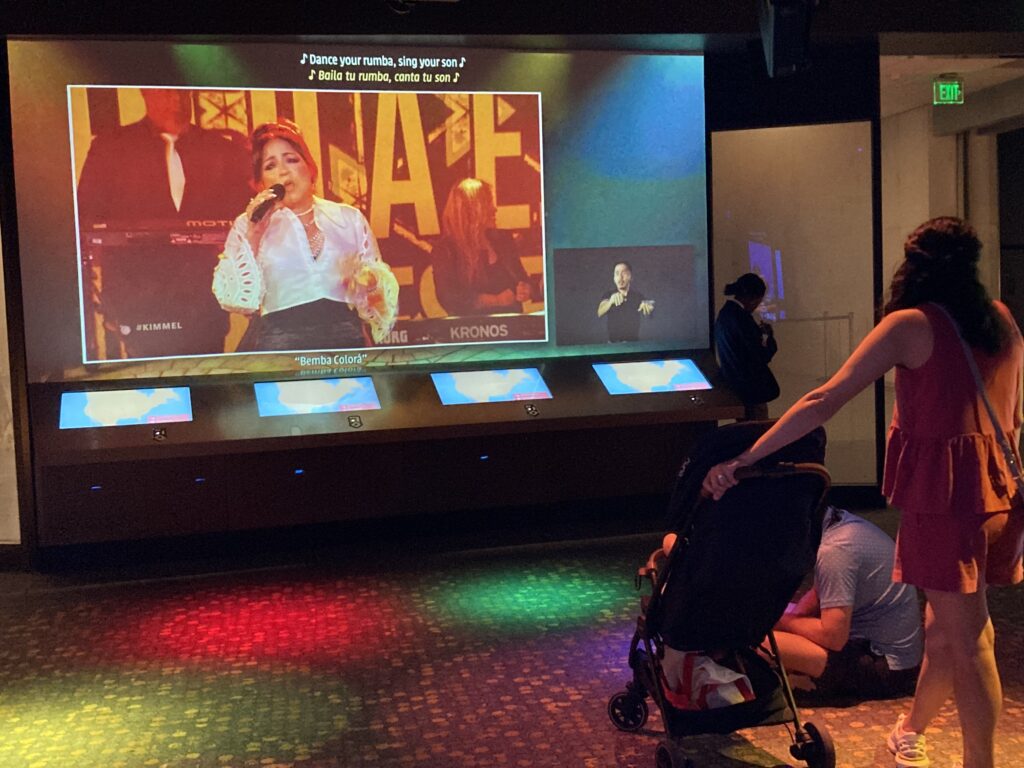
Visitors to NMAH’s Molino Family Latino Gallery watch a performance video in the exhibition “¡Puro Ritmo! The Musical Journey of Salsa.” Photo by Richard Selden.
On the gallery’s sides are two glass-fronted, photo-and-artifact-filled display walls like those in Hall of Fame museums. Among the topics covered: Cuban Roots, Puerto Rican Roots, Afro-Cuban Music, American Tourism in Cuba, Salsa’s Golden Age, Fania Records’ Empire, Salsa and Politics and Salsa Today.
“Queen of Salsa” Celia Cruz’s shiny red shoes with cantilever heels are next to a conga belonging to Texas-born Poncho Sánchez, who will turn 75 on Oct. 30. Other featured performers: “The Great Architect” Arsenio Rodríguez, a blind Cuban who played the guitar-like tres; Puerto Rican-born singer, percussionist and composer Myrta Silva; “Peerless (Sin igual)” salsa singer Héctor Lavoe; and Panamanian singer and activist Rubén Blades, 78.
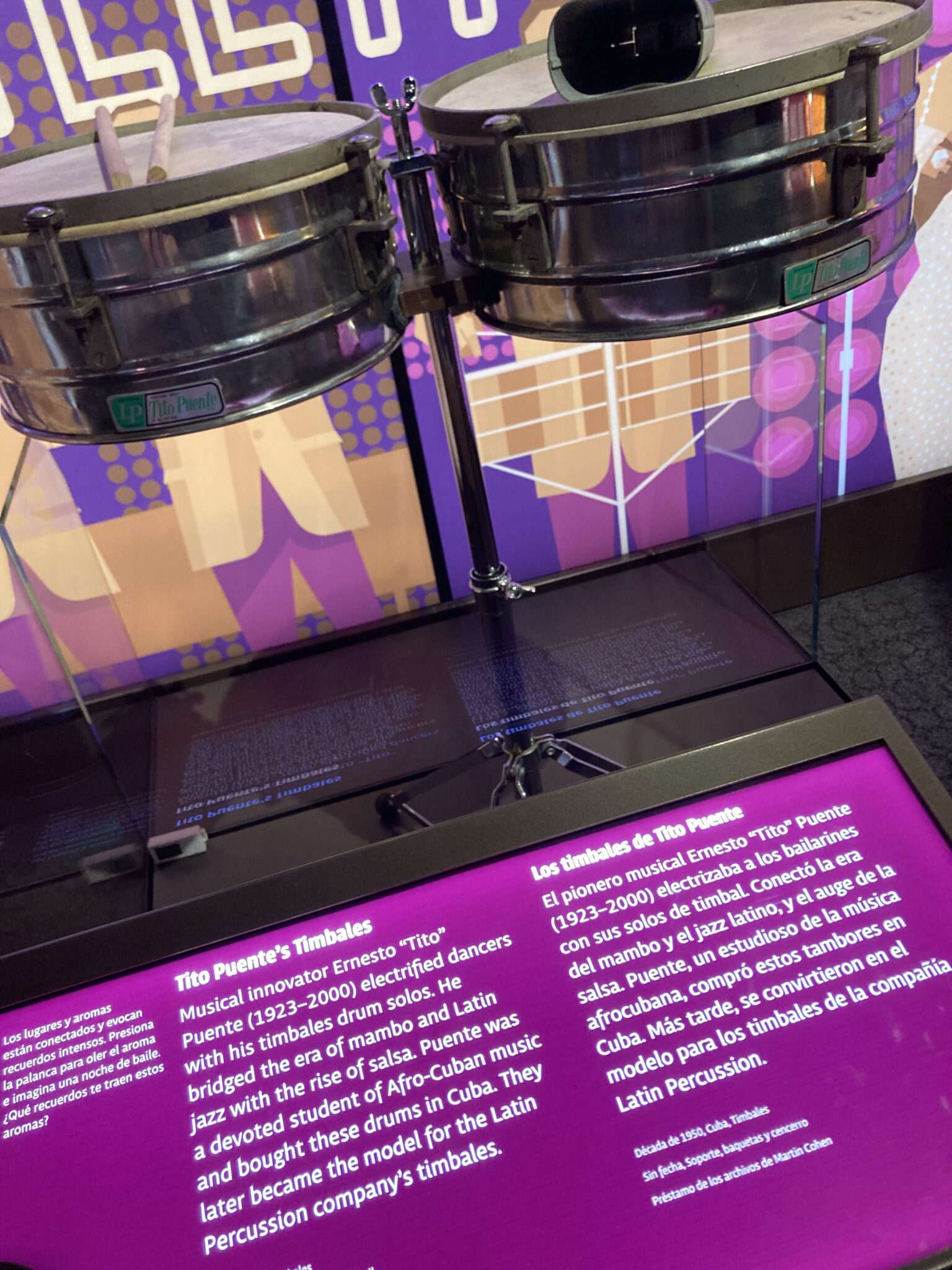
Tito Puente’s timbales. Photo by Richard Selden.
The gallery’s rear section contains the tiny Somos Theater, the General Motors Learning Lounge and a replica of part of a circa-1968 record shop, in which visitors can flip through bins of “albums” (boards with cover images). Continuing the story are displays titled Crossover Rhythms, The Early 1960s, The Late 1960s, African Heritage, ¡Mambo! and The Birth of Latin Jazz, where one can admire Cándido Camero’s pedal-operated cowbell, inscribed: “INVENTO DE CANDIDO N.Y.C. 1950.”