
Initiative 82: The Tipped Wage Controversy Continues
By • March 11, 2025 2 1433
By Zoe Howard-Barr
Overwhelmingly passed in 2022, Initiative 82 has been steadily reshaping the city’s labor landscape since going into effect in May of 2023. The measure incrementally raises the hourly wages of tipped workers. It is designed to gradually eliminate the tip credit — an allowance that lets employers pay tipped workers below the standard minimum wage if tips make up the difference. The initiative has sparked debate about its benefits and challenges.
Before the phased implementation began, the tipped minimum wage in D.C. was just $5.35 an hour, a rate heavily reliant on tips to make up the rest of tipped workers’ incomes. Since then it has risen to $10 an hour, with a jump to $12 planned for this July. By 2027, the tipped minimum wage will match the minimum wage of all D.C. workers, currently $17.50.
The legislation is seen as a major win for tipped workers, who are more vulnerable to wage theft, harassment and other exploitation. The wage increases create a more stable income and particularly benefit women, people of color and low-income workers, groups disproportionately represented in the tipped workforce. Supporters argue that this is a necessary move toward economic equity.
The shift has not been easy for local businesses. As tipped minimum wages continue to climb, businesses, notably restaurants, are finding it harder to sustain their operations without increasing prices or cutting back on staff.
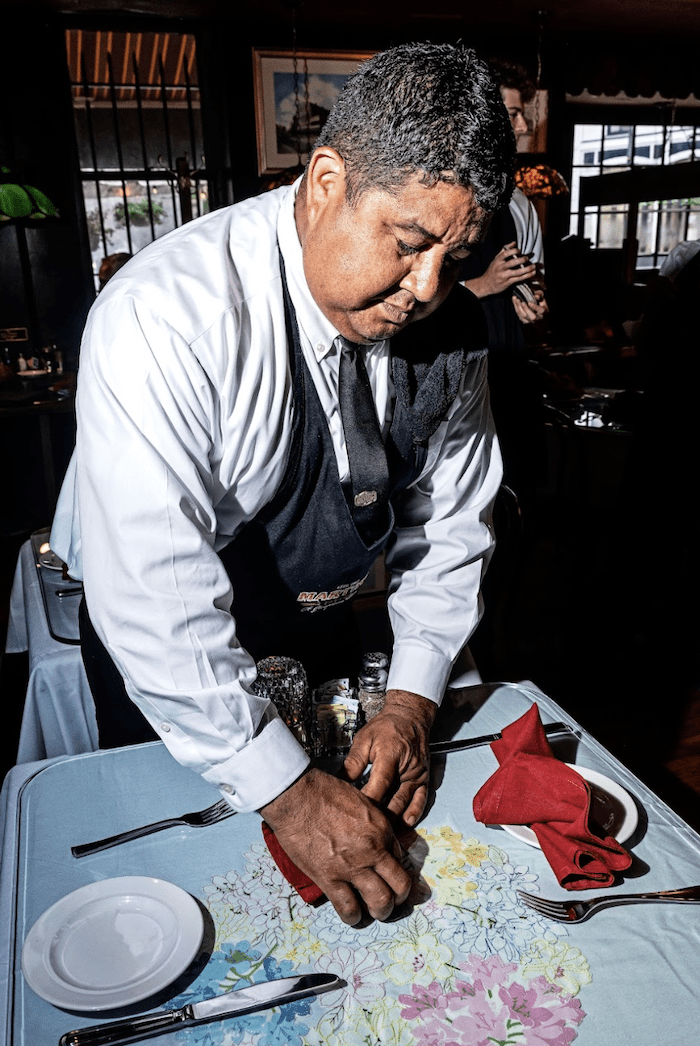
A Martin’s Tavern employee prepares a table. Courtesy Martin’s Tavern.
The loss of 1,800 restaurant jobs since May of 2023 highlights the added strain of the wage increases and the elimination of the tip credit, even if post-pandemic economic conditions and staffing shortages are also contributing factors.
Billy Martin from Georgetown’s historic Martin’s Tavern is passionate about the issue. He expressed deep concern: “There are independent restaurants and huge corporate restaurants. When Initiative 82 is fully implemented, many of the smaller restaurants will be forced to adjust their models so drastically that it will inevitably cost jobs or close their doors for good — therefore changing the fabric and diversity of this great industry as we know it.
“We see this already with the closing of more than 70 restaurants in the Washington area since Initiative 82 has been implemented or many who are relocating to Virginia and Maryland.”
Martin continued, “What I-82 is doing is creating confusion and challenges with how to adjust for the additional payroll expense. Higher menu-item prices or adding an operational fee is also challenging and confusing. By the way, D.C. has one of the highest minimum wages in the country. It’s a shame that this great industry, the second highest revenue generator other than the federal government in Washington, D.C., is being adjusted this way.”


As the minimum wage for restaurant workers goes up (and I applaud that for putting those employees on a more reliable/stable income), patrons should consider decreasing their tip percentage, because those tips are no longer so vital to saving workers from a ridiculously low minimum wage. The staff’s increasing minimum wages are now reflected in our increasing restaurant entree bills. So, reciprocally, the tip percentage should go down. All the more so because the “standard” tip in recent years has gone up from 15% to 20%, for no obvious reason.
This suggestion may not sit well with staff at many of our Georgetown restaurants, because the high cost of meals here gives them high tips (esp. when derived from a 20% standard). But the DC minimum wage law was intended primarily to help those in low-end restaurants who could barely make it on a ridiculous minimum wage combined with low tips. It was not designed for waiters at high-end restaurants, whose tips may far exceed their actual hired wages. And that is the reason many of them opposed the DC referendum which altered the minimum wage law. But sorry, I don’t feel like paying twice over for higher restaurant prices to increase the minimum wage and then also an escalating tip custom (from 15 to 20%). The latter needs to “give” to accommodate the new minimum wage measure.
There is obviously a lot of misunderstanding and misinformation around this issue. The following encapsulates perfectly the misunderstanding: “But the DC minimum wage law was intended primarily to help those in low-end restaurants who could barely make it on a ridiculous minimum wage combined with low tips.”
This is simply not accurate and shows how well-meaning voters were duped into voting for a ballot initiative plagued with misinformation. The key is: No matter what, nobody makes less than the full minimum wage.
So how does the system work? Simple: If the lower tipped-minimum wage plus tips does not get the server/busser/bartender/etc. to the regular minimum wage (the highest in the country), then the owner pays the difference. This is automatically calculated by the payroll company, so absent outright theft and fraud, this is not something we can manipulate.
And if someone is determined to steal from and defraud their employees — possible but relatively unlikely in a market where we are all struggling to find qualified, dependable staff who could and would go elsewhere if we stole from them — well, that can happen under I-82 just like it could happen before I-82. I-82 makes no difference in that regard.
Servers and other tipped workers already get the full minimum wage — at least — which, again, is the highest in the United States. And servers at even mid-priced restaurants — to say nothing of the Palm and such — will have servers and bartenders making $40-50/hour and bussers and barbacks making $25-30/hour.
I-82 is not about helping hard-working restaurant staff. We love our hard-working staff, and we are proud to see them making up to six figures in our mid-priced restaurant ($45-50 check average). I-82 is about an out-of-state political organization trying to bolster itself at the expense of the DC dining scene.