
University Presidents Testify Before Congress on Campus Antisemitism
By • July 28, 2025 0 1136
By Maren Fagen
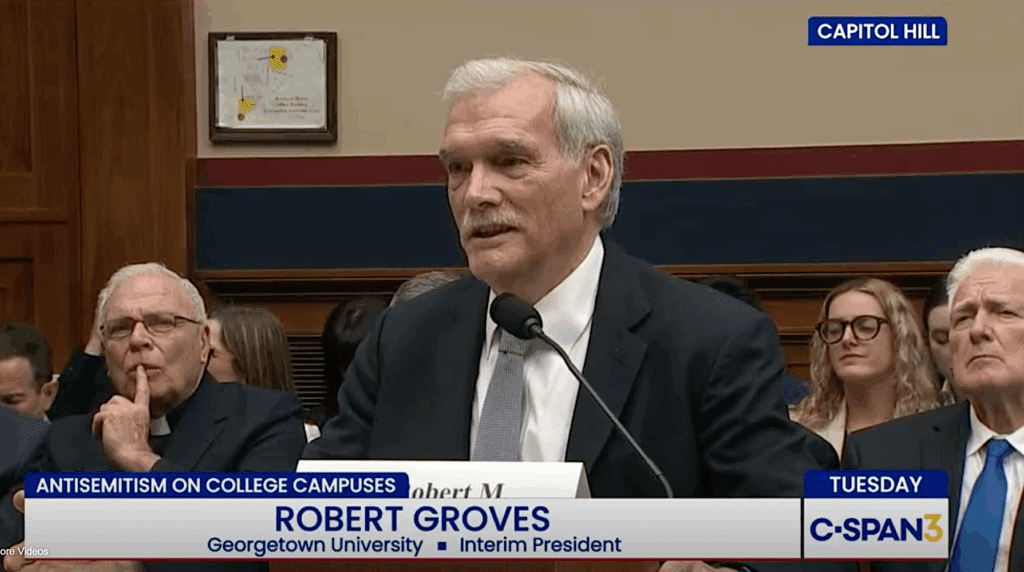
Three university presidents, including Georgetown University Interim President Robert Groves, testified before a congressional committee on July 15 about college antisemitism.
Groves, the City University of New York (CUNY) Chancellor Félix V. Matos Rodríguez and University of California, Berkeley, Chancellor Rich Lyons testified in a three-hour hearing before the Committee on Education and the Workforce, a House of Representatives committee overseeing education at all levels. This hearing was the ninth hearing regarding college antisemitism before the committee since the outbreak of the Israel-Hamas war.
Rep. Tim Walberg (R-Mich.), the committee’s chair, said the hearing aimed to address factors the committee believed could incite antisemitism on campus, including faculty and student groups, as well as foreign funding.
“Today’s hearing marks the next phase of the Committee’s work—an effort to understand why this wave of antisemitism was able so easily to consume the nation’s universities in the first place,” Walberg said in opening statements at the hearing.
Groves was the first witness to deliver an opening oral presentation, outlining Georgetown’s actions to prevent antisemitism.
“Since 1789, as the first Catholic and Jesuit U.S. university, Georgetown’s religious beliefs have demanded the absence of antisemitism and other hatreds,” Groves said during his presentation.
“Indeed, the church has directed the Jesuits to foster dialogue across all religions. Therefore, any hatred or fear among our students destroys that dialogue,” Groves added. “Antisemitism is incompatible with living our mission, and the same applies to Islamophobia and racism.”
Rodríguez and Lyons followed Groves, further outlining what their universities have done to combat campus antisemitism.
“Speech that is protected by the First Amendment can still contribute to a hostile environment, and universities are obligated to do something about it,” Lyons said during his opening statement.
Matt Nosanchuck, a civil rights lawyer who fought against antisemitism during the Obama administration, also testified alongside the university presidents. During his opening presentation, Nosanchuck said the presence of antisemitism on campus is “real” and its response must be quick.
Nosanchuck also said the Trump administration’s approach to combat antisemitism is “contradictory and counterproductive” as the work includes a “crackdown” on foreign students and “gutting” offices that could adequately support colleges working to end antisemitism.
After the opening statements, each president faced questions from the committee members.
Groves primarily received questions regarding Georgetown’s campus in Qatar (GU-Q), a campus Groves said supports Georgetown’s values in the Middle East. Groves said GU-Q is “completely consistent with the Jesuit animation of working at the frontiers of serving groups that are not served easily in Washington.”
Lyons’s questions primarily referenced Jewish student and faculty safety on campus, including incidents from faculty members that the representatives said were antisemitic. Rep. Lisa McClain (R-Mich.) specifically questioned Lyons about the social media posts from a professor, who Lyons said was a “fine scholar” during the hearing.
Groves also responded to questions of alleged faculty antisemitism, including posts from faculty that some interpreted to be a call for violence. When asked about Georgetown’s response to the alleged antisemitism by a faculty member, Groves said the faculty member was removed under administrative review. Groves also said members of the university administration “police carefully the behavior of our faculty in the classroom and their research activities.”
Rodríguez faced questions that in part focused on the clashes between CUNY students and the New York Police Department, graffiti found on campus buildings and CUNY CLEAR, a legal clinic that supports the civil rights of Muslims.
Closing the hearing, Walberg said the hearing was a long but important one.
“We need to continue to highlight bad actors in our higher education institutions,” Walberg said. “That’s the reason we have an education and workforce committee to deal with education.”


