Smithsonian Preps Teachers for 2026
By • August 7, 2025 0 964

Can you say semiquincentennial? In 2026, the United States will be halfway to 500 years old.
When a British chemist and mineralogist named James Smithson passed away in his 60s in 1829, leaving an inherited fortune to his likewise unmarried and childless nephew, our nation was a youthful 53.
Six years later, the nephew died without heir. In accordance with Smithson’s will, the remaining funds were bequeathed to the United States of America, “to found in Washington, under the name of the Smithsonian Institution, an establishment for the increase & diffusion of knowledge among men.”
Congress accepted the gift of over a half-million dollars — along with Smithson’s library, papers and personal effects — and on Aug. 10, 1846, formally established the Smithsonian, now the largest museum, education and research complex in the world.
In the top administrative spot since 2019 is historian Lonnie G. Bunch III, the 14th secretary of the Smithsonian, previously associate director for curatorial affairs at the National Museum of American History, president of the Chicago Historical Society and founding director of the National Museum of African American History and Culture.
The Smithsonian’s deputy secretary is Meroë Park. The four under secretaries are: Ronald Cortez, finance and administration; Kevin Gover, museums and culture; Ellen Stofan, science and research; and Monique M. Chism, the first official holder of a position created in 2021, under secretary for education.
While “the Smithsonian has always had a leadership position for education,” said Dr. Chism, “Secretary Bunch had a vision to ensure that education across the institution was considered and elevated in the same way that we’re thinking about our science, research, museums and cultural centers.”
Prior to joining the Smithsonian, Dr. Chism, who earned her Ph.D. in American studies at Michigan State University, served as deputy assistant secretary at the U.S. Department of Education, then as vice president at the American Institutes for Research, a nonpartisan nonprofit.
Soon after she arrived, the Smithsonian held its inaugural National Education Summit, a one-day virtual event. The fifth Summit took place this year on July 15, 16 and 17.
“The first day is still completely virtual. The second day is hybrid, where participants are in person, but they’re also then joining the keynote sessions via livestream. And then the third day is completely in person at our museums — kind of deep-dive sessions that are often behind the scenes, working with our museum educators,” she explained.
With the semiquincentennial in mind, this year’s theme, “Together We Thrive: One Nation, Indivisible,” comprised four tracks: Many Voices, One Nation (“thinking about … contextualized historical experiences from multiple perspectives”); The Power of Place (“how does your own local story … complement, connect, extend the national story?”); Transformative Teaching Tools (“brass tacks, frameworks, toolkits, lesson plans that teachers can take and use right away”); and Past, Present and Future (“how to really connect civic engagement and civic learning”).
“We were helping educators get ready for teaching the semiquincentennial for next school year, so providing them with … all types of resources … and then also opportunities for networking with peers across the nation that they can call on throughout the year.”
Registration was free; the Summit had roughly 500 in-person attendees and more than 3,000 online participants. Many sessions were recorded and will be posted this month on the Smithsonian’s YouTube channel.
One keynote presenter was National Teacher of the Year Ashlie Crosson, “who talked about the work that she’s doing with storytelling in her community in Pennsylvania.” In a “really powerful course … called Survival Stories,” Dr. Chism said, “she gives students an opportunity to connect to historical figures that were teenagers.”
Another keynote was by Carlotta Walls LaNier, the youngest member of the Little Rock Nine, the first Black students at Central High School in Little Rock, Arkansas, who brought “a very human connection to a historical story.”
More Summit highlights: “a conversation with Secretary Bunch, who really helped to frame the importance of the founding ideals of our nation … and how we are continually working to achieve that vision of the Declaration of Independence”; and a panel discussion with the directors of the National Museum of African American History and Culture, the National Museum of American History and the two Smithsonian museums in development, the American Women’s History Museum and the National Museum of the American Latino.
The dates for the 2026 National Education Summit are July 14 to 16. A program underway in the meantime is Democracy in Dialogue, a virtual exchange. “We’re working with teachers in different communities,” said Dr. Chism, “so you can imagine a teacher in Texas paired with a teacher in Montana. And the students that they bring together have a question: How has my community contributed to the 250-year experiment of the nation?”
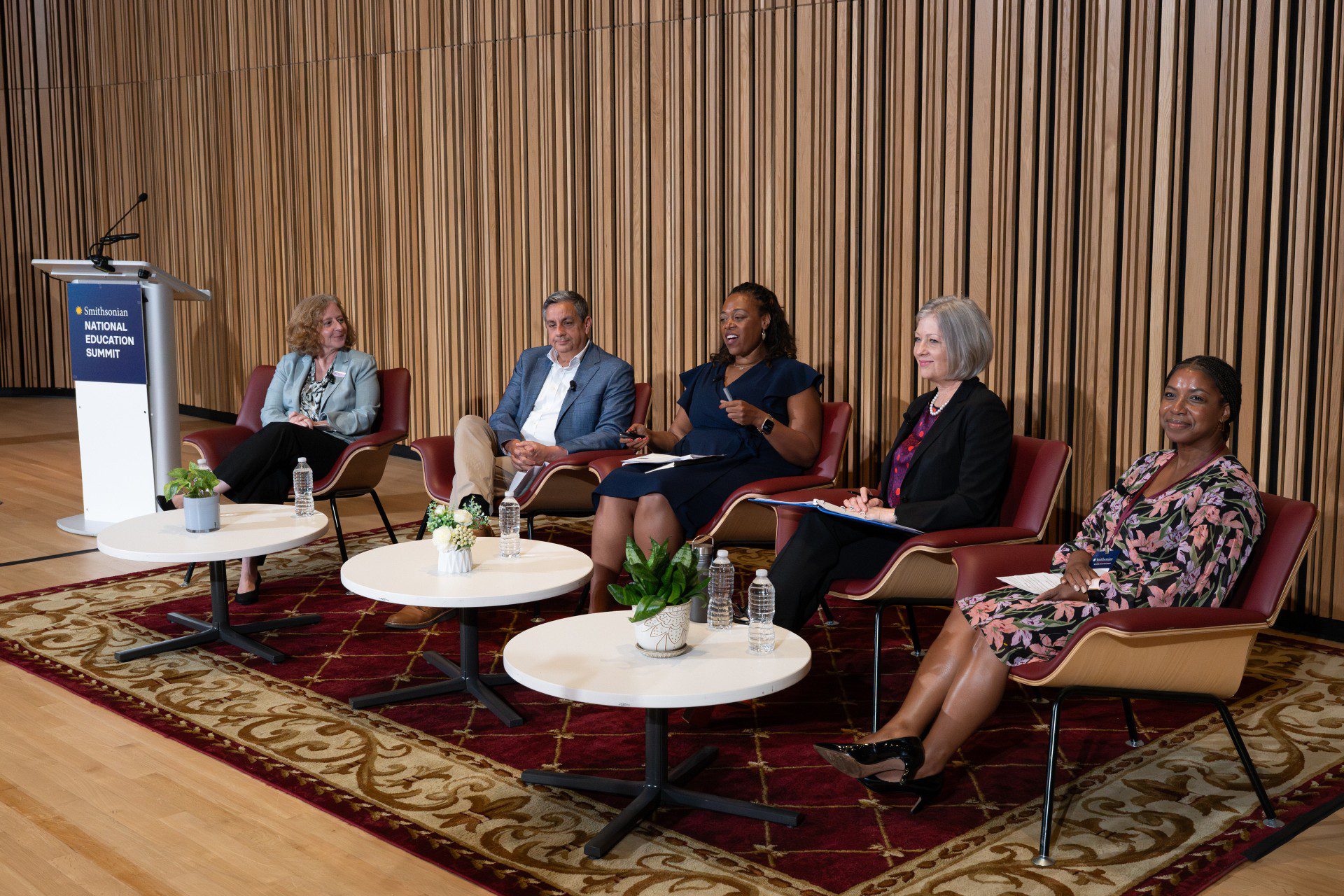
Smithsonian Under Secretary for Education Monique M. Chism (center) moderates a panel on the Declaration of Independence with museum directors (left to right): Elizabeth C. Babcock of the American Women’s History Museum, Jorge Zamanillo of the National Museum of the American Latino, Anthea M. Hartig of the National Museum of American History and Shanita Brackett of the National Museum of African American History and Culture. Photo by Norwood Photography. Courtesy Smithsonian.
Her office is also active locally. “We do a lot of work with [District of Columbia Public Schools], but also with Maryland and Virginia schools. Specifically with DCPS, they have a program called Capstone. And we work with all of their teachers at the different grade levels to connect those learnings to the experiences in our museums,” said Dr. Chism. “We definitely get a lot of field trips from D.C. schools, but, for example, one of the Capstones is connected to our Air and Space Museum. … One of our museum educators from National Air and Space co-teaches with the DCPS teacher. They do different things throughout the semester, but then students also spend a lot of time at the Air and Space Museum applying what they’ve learned.”
“There are over 300 people who are connected to Smithsonian Education,” she noted. “I have an opportunity to connect with all of them at least once a month, but then I connect with the leadership of each one of the museum education programs on a more regular basis.” In addition, “my office runs a professional learning group where six of the museum educators have dedicated time on my staff to help to support collaborations.”
As with the Democracy in Dialogue program, a lot happens virtually. “People are accessing information in different ways than they were 50 years ago,” commented Dr. Chism. “And so I think the museum and cultural industry really does have to think about what are museums of the future. What does it mean to have an engaging experience, not only within the walls of your cultural institution, but how can we meet people where they are, using technology?”
She pointed to si.edu, where there is a resource called Learning Lab, “a digitized platform of many of our objects, and you just put a search in and there’s a lot of just unique resources that will pop up.” Her office is also curating a new website “that will be available for anyone — for parents, for homeschoolers, for teachers.”
Smithsonian Education puts out a monthly online newsletter and invites educators who would like to take advantage of Smithsonian materials and expertise to get in touch.
“How can we reach classrooms, how can we reach homes, how can we reach communities across the nation? And so that’s a lot of the work that I’m doing also, is helping to bring our work out to the nation,” Dr. Chism said.


