
Washington Welcomes Watergate Museum
By • February 4, 2026 0 140
Lessons from history are relevant today, quips the passionate—and perhaps idealistic—Keith Krum. If he succeeds in this venture, Washington may gain one more museum to preserve that—The Watergate Museum.
Of course, many may remember the Watergate as the site of the failed break-in of the Democratic National Committee headquarters occurred in 1972 and then the cover up leading to President Richard Nixon’s resignation two years later.
When questioned “why now?” Krum, who is an attorney and a Watergate resident, also works for the non-profit Veterans Consortium and is Chairman of the Board of the soon-to-be Watergate Museum.

Laurie Munn with her portraits.
“At the time, the Watergate complex itself was unique and controversial,” Krum said. “It was not only one of the country’s first urban developments to include residential, office, hotel and retail space, but its curves and swirls changed D.C.’s skyline.”
Designed by Italian architect, Luigi Moretti, it was long the iconic address in the nation’s capital.
“The political events that occurred there in 1972 gave Watergate international fame,” Krum said. “Like it or not, today it’s back in the headlines.”
Krum explained that people are curious. “Young people walk by and say ‘OMG, that’s the Watergate!'” Although their grandparents watched the Watergate hearings on TV and they know it has a story, many don’t know what that story is.

Laurie Munn with her portraits.
Krum points out that it’s not just civics education that’s needed; it’s the “need for civility as well.” That’s where the co-op side of the Watergate comes in. “Anyone who’s lived in a co-op building, knows you share in the responsibilities, you share in the burdens, you share in the assets, and you can’t get anything done unless a majority of the people agree to come together,” Krum said.
He explained the analogy in his civics elevator pitch: “Today’s politics is very polarized. If people learn about a time when government institutions worked together to protect the rule of law, then I think they can see that it can happen.”
“Politicians were not always as polarized as today, there was a time when people believed in government and law,” Krum said. He hopes we can return to those times with the help of the proposed museum.
In addition to the Board—all of whom are Watergate residents—the Advisory Council includes key names from the era: special prosecutorr during the Watergate scandal Richard Ben-Veniste and Jill Wine-Banks, assistant Watergate special prosecutor.

Keith Krum with Munn’s portraits in temporary Watergate exhibit. Photo by Karen Feld.
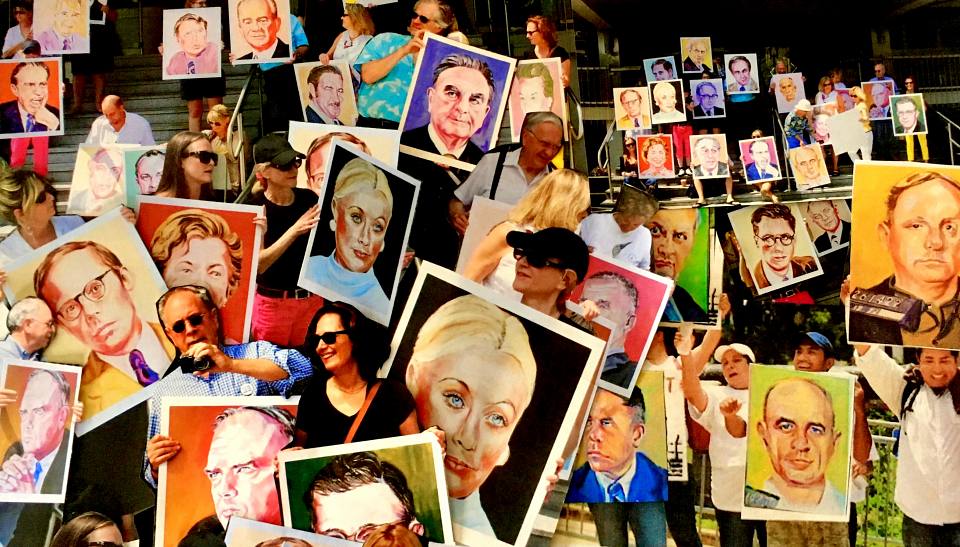
Those on the museum’s board are hoping to raise $3.5 million to make this happen within the Watergate complex. Currently, an art exhibit with New York artist Laurie Munn’s portraits of key players is on view on the lower level of the complex until April 25.
Munn, now in her 70s and living in Tarrytown, NY, describes herself as a “serial portrait painter.” She remembers growing up in “Nixonland” in Southern California and visiting friends who had portraits of President Nixon hanging over the mantle in their living rooms. As an aspiring artist, she was fascinated by that and the Watergate hearings on TV. She has done both a presidential and a First Lady series. For this series, she painted a portrait a day, capturing facial expressions—Dick Cheney’s smirk, Martha Mitchell’s cleverly orchestrated leaks, Nixon’s personal secretary Rosemary Woods, Washington Post reporters Bob Woodward and Carl Bernstein, Watergate Committee members Senators Howard Baker and Fred Thompson, John and Maureen Dean and on and on. It’s still a work in progress.
Munn painted the artwork between 2008 and 2010. She showed them at the Watergate Gallery in 2012 to celebrate the 40th anniversary of the break in. Although the artist had offers for some, including from John Dean, she declined to sell any single portrait. “It’s a story; I don’t want to break it up,” she said.
In Dean’s case she made a poster of both his and that of his wife, Maureen, for him, but the artist kept the original.
John Mitchell is one of her favorites of the 82 portraits in this series. It’s the only one that she didn’t finish. She painted the series in acrylic except this one, which is oil paint on a heavily gessoed background. “It turned out so well that I said, I’m just leaving it like this,” Munn said. “A few are smaller because I didn’t get to the art store to buy a larger canvas.”
Another artist favorite is her portrait of Nixon’s personal secretary, Rosemary Woods, who lived in the Watergate. Since Woods erased the tape, Munn painted a large portrait of her with her foot on the pedal.
Her pop-up show honoring the 40th anniversary of Watergate and Washington Post editor Ben Bradlee was held in the Democratic National Committee offices that were broken into. “I hung all the plumbers’ portraits at the spot where they broke in,” Munn said.
Munn is taking a break from her current project, “The Trump Show,” to complete the Watergate series. “It’s so awful,” she chooses her words carefully, “It’s not the same, but I’m doing some nice portraits of them in their horror mode.”
Watergate is the artist’s second favorite series—she remembers the Watergate complex from when she went to art school in Baltimore. Her favorite series was painting a 1965 yearbook she found on the street from her high school graduation year. Years later, she found the students on the internet and painted all 220 portraits and then threw a reunion for them. She sees a similarity with Watergate because just as she met Ben Bradlee, Bob Woodward, Carl Bernstein, Bud Krogh (one of the plumbers), John Dean and others, she got to meet many of the cast of characters after researching and doing their portraits.
Krum, aside from being Watergate resident, has a personal connection—his favorite portrait of his former history professor and mentor at Boston University, Archibald Cox. Krum describes Cox as “a riveting storyteller and very humble.”
Design Lines created the architectural drawings for the museum, which even include recognizable balcony teeth for the display as well as the curved shape of the Watergate itself.
As plans for the Watergate Museum move forward, the project aims to do more than preserve a pivotal moment in American history—it hopes to remind visitors of the importance of accountability, civic engagement, and institutional trust. By revisiting a time when the system held firm, the museum hopes to inspire a clearer understanding of how democracy can endure and why its lessons still matter today.


