The Washington Winter Show: American Design at 250
By • January 15, 2026 0 386
By Zoe Shields
Hung in a gilt frame, an oversized gouache on paper depicts the early hills of Washington. Scene-flanking trees give to the wind and the sky is a dense, leaden blue that echoes in the contours of the landscape below. The adventuring figures in the fore situate the work as meaningfully intended: this is new ground.
“Georgetown and the City of Washington c. 1800” by George Beck—an English American born in 1748 and pioneering painter of the American wilderness—captures Washington as an unfinished experiment and a land with promise. Offered by Philadelphia’s Arader Galleries at the Washington Winter Show, the piece is one of the earlier views of Washington, D.C., in which both possibility and restraint are present.
Framed by a view looking north up the Potomac River, Beck captures a burgeoning Georgetown in the distance as the future site of the Capitol, selected by President Washington, emerges in the right mid-ground. The land reads as welcoming and fertile, and at the time he painted this north view, Beck was engaged in a presidential commission, capturing the river for Mount Vernon.
The promise visible in Beck’s landscape would continue to migrate indoors to shape an American interior. The Washington Winter Show—the second oldest charitable antiques show—is particularly tone-setting for the design community in the nation’s semiquincentennial year. The show invites both designers and audiences to consider how heritage informs creativity today and how American interiors, in their evolution, continue to tell the story of the nation itself.
Dealers are important custodians of these national design narratives, shaping how early American ideals are preserved and made legible in the present. At the Winter Show, their selections extend beyond the market and serve as assertions of what endures.
Frances Purcell Inc.—specialists in American 18th and early 19th century wooden mantlepieces and a former supplier of fine antiques to the White House—presented an impressive selection, including an early-surviving c. 1790 chimneybreast. With crossetted corners and round-shaped trunnels, it represents a compelling example of early American traditional millwork. Much of its original paint survives, alternating shades of smalt and powder blue, deliberately chosen to reflect firelight and maximize brightness after dusk.
Satinwood shaped the material conversation across the show. At Richard Worth Antiques, a c. 1780 secretary desk anchored the theme, its chartreuse leather inlay beautifully timeworn. Around the nation’s founding, satinwood was beginning to circulate among elite Anglo-American interiors, prefiguring the Federal period’s preference for luminous, finely grained woods.
The show also traced America’s early global consciousness through objects that furnish diplomatic interiors. The Fund to Conserve U.S. Diplomatic Treasures Abroad and its public sector partner, the U.S. State Department’s Office of Cultural Heritage, presented objects from numerous U.S. diplomatic posts, globally—the largest holdings of which are in London, Paris, Prague and Rome.
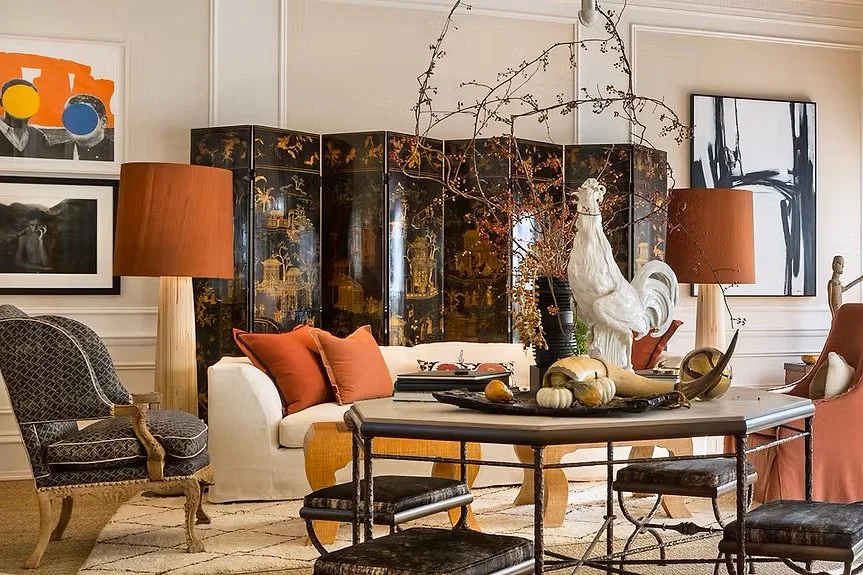
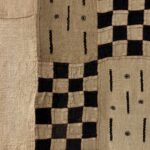
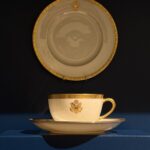
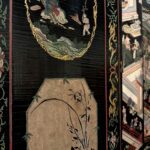
Among the works on view were a gauzy, hand-dyed raffia palm cloth, woven from harvested fiber by the Kuba people of Central Africa, that hangs in the U.S. Embassy in Nairobi, Kenya. There was also an oversized Chinese coromandel screen, depicting an imperial tableau across twelve lacquered wood panels, displayed in the Ducale Room at the U.S. Ambassador’s Residence in Brussels, Belgium. Finally, there was a dinnerware set bearing the American eagle—formerly used by John B. Stetson, Coolidge-appointed Minister to Poland, and his ambassadorial successors—that survived upheavals of the communist era.
Georgetowner photos.
-

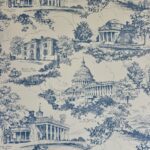
- The Washington Toile. Lewis & Wood.
-
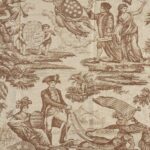
- Schumacher-Toile.
-
- Kuba Textile. U.S. Embassy Nairobi.
-
- Georgetown City of Washington. George Beck.

-
- Crested Dinner Service. U.S. Embassy Warsaw. Georgetowner photo.
-
- Chinese Coromandel Screen. U.S. Embassy Brussels.
-
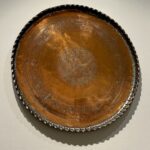
- Antique Middle Eastern Serving Tray. U.S. Embassy Damascus.