
Last Chance: Osgemeos at the Hirshhorn
By • July 31, 2025 One Comment 1102

Though South Jamaica, Queens, has a rival claim, the majority opinion holds that hip hop began in the Bronx. Its birthplace has even been pinpointed: the community room of an apartment building at 1520 Sedgwick Ave., where on Aug. 11, 1973, Clive Campbell — later DJ Kool Herc — gave the turntable a workout at his sister’s back-to-school party.
Hip-hop culture — DJing, rapping, breakdancing and tagging (as in graffiti) — became a worldwide phenomenon in the 1980s. Among the millions enraptured were identical twin brothers entering their teens in the Cambuci district of São Paulo, Brazil: Gustavo and Otávio Pandolfo.

“The Little Giant,” created by Osgemeos in 2023, crouching in the Hirshhorn Museum’s central plaza through Aug. 3. Photo by Richard Selden.
This weekend is your last chance to enter the Pandolfo twins’ hallucinatory universe of (mostly) yellow-skinned beings at the Hirshhorn Museum. The 10-month retrospective “OSGEMEOS: Endless Story,” organized by Marina Isgro, associate curator of media and performance art, closes on Sunday, Aug. 3.
Make the effort, because in one fell swoop you can connect with contemporary Brazilian visual culture — unfamiliar to most of us — and trace the route to art-world stardom of a pair of lowly taggers, comparable to the better-known path of Keith Haring and Jean-Michel Basquiat.
Another reason to catch “OSGEMEOS”: surprises for eye and mind are around every corner (if the Hirshhorn had corners).
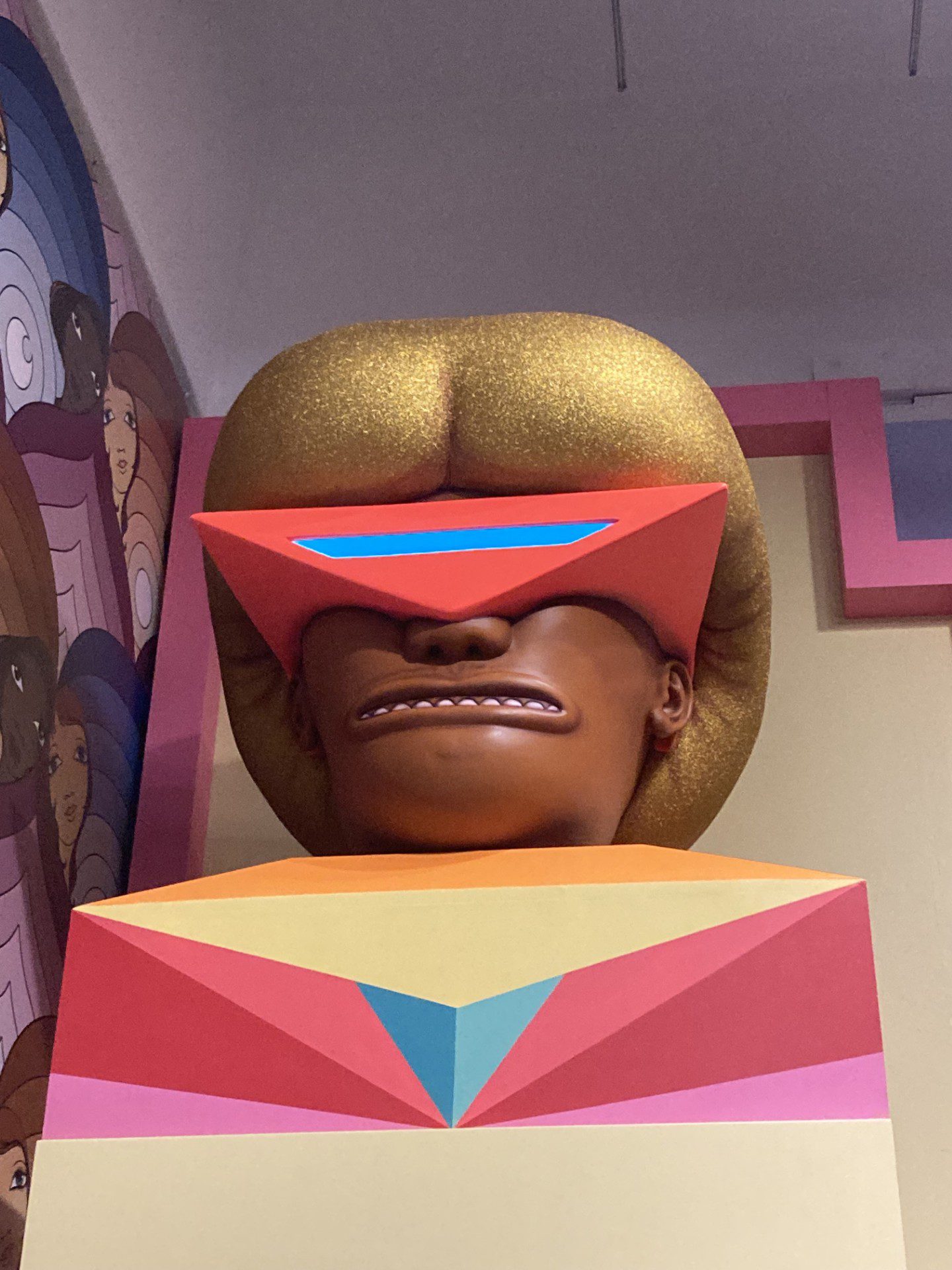
An upper corner of “The Tritrez Altar” of 2020, now on view at the Hirshhorn. Photo by Richard Selden.
With the same Latin root as the zodiac sign Gemini, the Portuguese phrase os gêmeos (pronounced “oosh ZHEY-me-oosh”) means the twins. Born on March 29, 1974, Gustavo and Otávio began scribbling scenes from their conjoined imaginations as toddlers. Now in their 50s, they have never stopped depicting this vibrant personal dreamworld — thus, “Endless Story.”
But why are their signature characters “Simpsons” yellow?
“When we were drawing at our mother’s house, the sun would come through the windows and the studio would become yellow,” they (it’s unclear which twin) told Sasha Bogojev in a 2018 Juxtapoz Magazine interview. “So we always found it mystical, peaceful and harmonious.”
A breakthrough came in 1993. San Francisco street artist Barry McGee, in São Paolo on a residency, called the number on a street painting that impressed him and was asked to dinner. With their Lithuanian Brazilian mother, Margarida Leda Kanciukaitis Pandolfo, translating, it took a while before the brothers realized that McGee was famed tagger Twist, whose work they knew from skateboarding magazines.
McGee provided mentorship and contacts that led to public commissions, gallery representation and invitations to participate in museum shows. Osgemeos was one of six creative units (for lack of a better term) in the high-profile “Street Art” exhibition at London’s Tate Modern in 2008, the others being Blu from Bologna; Faile, a collective from New York; JR from Paris; Nunca, their fellow Paulista; and Sixeart from Barcelona.
Osgemeos’ first solo exhibition at a U.S. museum followed in 2012 at Boston’s Institute of Contemporary Art. Their 70-by-70-foot mural “The Giant of Boston,” on a ventilation building along the Rose Fitzgerald Kennedy Greenway, raised an outcry. The barefoot figure’s magenta jacket, wrapped around its yellow head, was (not unreasonably) interpreted as a headscarf. Was the Giant an Islamic terrorist? According to the Greenway Conservancy, however, the “yellow-colored character in brightly mismatched clothes” was “just peering at the busy city life unfolding below.”
Hirshhorn visitors will encounter “The Little Giant” — likewise yellow and barefoot, with white-painted toenails — seated with knees up and arms folded in the center of the museum’s circular plaza. An inflatable, the gnomelike creature has slitted eyes, a boxer’s flattened nose and tiny pointed teeth. Its balloonish head is topped with a helmet of purple-pink hair from which a fat curl rises front-and-center. Take that, Gordon Bunshaft (the museum’s austere architect).
Filling the third floor, the exhibition aims for near-archival comprehensiveness, displaying hundreds of childhood snapshots and drawings, preserved by the twins’ embroiderer mother, and many blown-up images of their public art, both unauthorized and commissioned.

The Pandolfo twins at the September 2024 media preview for “OSGEMEOS: Endless Story.” Photo by Richard Selden.
Though graffiti’s early years have been romanticized, and street art is now part of urban revitalization, Osgemeos’ tagger days are in the past. From the Juxtapoz interview: “People that do graffiti do it for themselves; it’s graffiti life and we respect it very much. But for us, it was necessary to have a space to create our environment.”
The twins’ evolution from 2D to 3D has been remarkable. Numerous small painted sculptures are on view in “Endless Story,” as well as a sound installation that puts the steampunk-y “Gramophone” of 2016 — a yellow-painted contraption with two modern turntables, two gramophone horns connected to plumbing, each with an odd light fixture, and three faces gazing out, two with speaker openings for mouths — in front of the wall-mounted boxes with faces of “Untitled (92 Speakers)” from three years later.
The show’s two absolute knockouts are “The Tritrez Altar” of 2020 and “The Moon Room” of 2022. Tritrez, says Osgemeos, is an invented word for “our parallel world that we believe that lives inside of us.” The altar, a mashup of a Flash Gordon-themed discotheque with an Egyptian tomb, is one wall of a gallery completely made over into a Osgemeos funhouse.
By way of contrast, one views “The Moon Room” through a wall of window-like openings; in a surrealistic Victorian bedroom, an illuminated, elongated head rests on a bed by a grandfather clock as if captivated by the opera arias one hears (growing up, the twins listened to opera recordings played by their Lithuanian grandfather).
In another gallery (spoiler), a figure stands in a red, orange and green cone beamed from a small flying saucer.
“Maybe we are aliens and we don’t know it,” explains Osgemeos in the Juxtapoz interview. (Going by their beards, eyeglasses and ballcaps, we’d never know it either.) “It’s a fun thing for us, something we’ve had a connection with since we were kids. We’d love to get abducted one day and see it, like I see you now.”
Through Aug. 3
Hirshhorn Museum
Independence Avenue and 7th Street SW


Wonderful!