
In Richmond: Shows, Festivals, Last Call for Kahlo
By • September 24, 2025 0 607

Slightly more than 100 miles from Washington, D.C., Richmond, Virginia, is the self-evident choice for a southbound, arts-focused getaway.
Are you free this weekend? This Sunday, Sept. 28, is the last day to see “Frida: Beyond the Myth” at the Virginia Museum of Fine Arts, 200 N. Arthur Ashe Boulevard. Among the paintings on view are some of Frida Kahlo’s most compelling, such as “My Dress Hangs There”; “The Suicide of Dorothy Hale”; and her self-portraits “in Velvet Dress,” “with Monkey” and “with Loose Hair.”

Old Pompey. Photo by Richard Selden.
But what’s most distinctive about this banner exhibition — along with its physical design, evocative of the artist’s Mexico City homes — is the inclusion of drawings; personal artifacts; footage of Kahlo and her husband, muralist Diego Rivera; and photographs of her by gallerist Julien Levy and celebrated photographers Lola Álvarez Bravo, Imogen Cunningham, Dora Maar and Nickolas Muray.
On these final days, “Frida: Beyond the Myth” is accessible from 9 a.m. to 9 p.m. The hours to visit the permanent collection galleries, some closed due to a multiyear expansion project, remain 10 a.m. to 9 p.m. on Thursday and Friday and 10 a.m. to 5 p.m. on Saturday and Sunday.
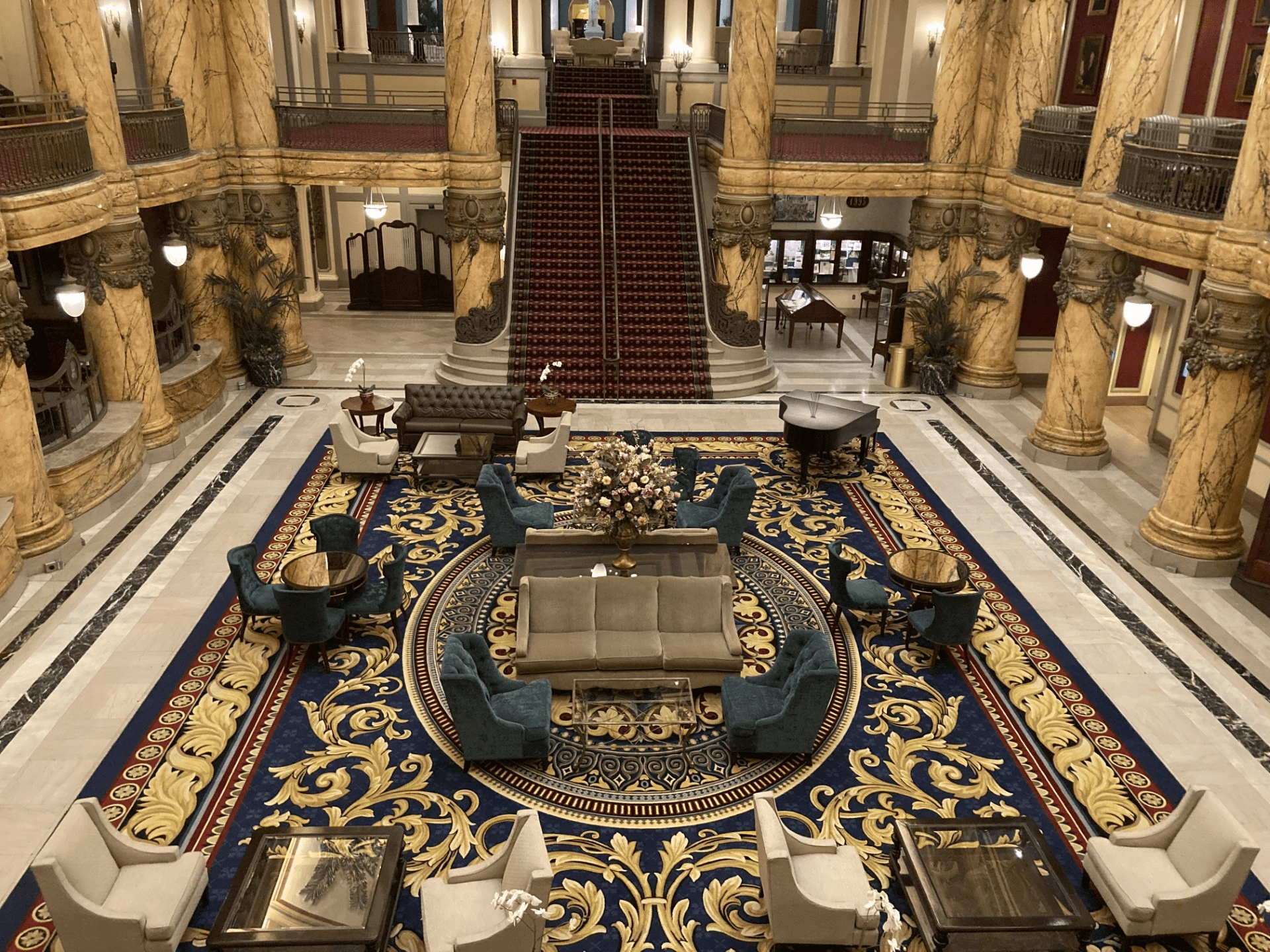
The Grand Staircase and the Rotunda at the Jefferson Hotel. Photo by Richard Selden.
A new exhibition, “Community and Continuity: African Art and Indigenous American Art,” opens this Saturday, Sept. 27. Looking ahead, “The Impressionist Revolution: Monet to Matisse from the Dallas Museum of Art” comes to the VMFA on Friday, Nov. 14.
Also this Saturday, Richmond is hosting two major festivals. Virginia Pridefest, presented by OutRVA and headlined by Saucy Santana, takes place from noon to 8 p.m. at Midtown Green, 2401 W. Leigh St. This year’s theme is “Live.Out.Loud.” The RVA East End Festival, supporting music and cultural arts programs at eight East End public schools, will be in Chimborazo Park, 3201 E. Broad St., from noon to 7 p.m., with art displays, a kids’ play area, vendors, food trucks and performances by local musicians and dancers.

The Jefferson Hotel entrance. Photo by Richard Selden.
Speaking of dancers, Richmond Ballet resumes its series in the VMFA’s Leslie Cheek Theater next month with “Moving Art Two: Director’s Choice,” featuring Artistic Director Ma Cong’s “French Twist,” Finnish choreographer Jorma Elo’s “Slice to Sharp” and a world premiere by South African-born choreographer Andrea Schermoly. Performances are Oct. 16, 17, 19, 23, 24 and 26.
What’s onstage in the River City? Ken Ludwig’s adaptation of Agatha Christie’s “Murder on the Orient Express,” directed by Rick Hammerly, is playing through Oct. 12 at Virginia Rep, 114 West Broad St. Starting tomorrow, Friday, Sept. 26: Cadence’s production of Eugene O’Neill’s “Long Day’s Journey Into Night” at the Firehouse Theatre, 1609 W. Broad St. Directed by Rusty Wilson, the Tyrone family will be hashing things out through Oct. 11.
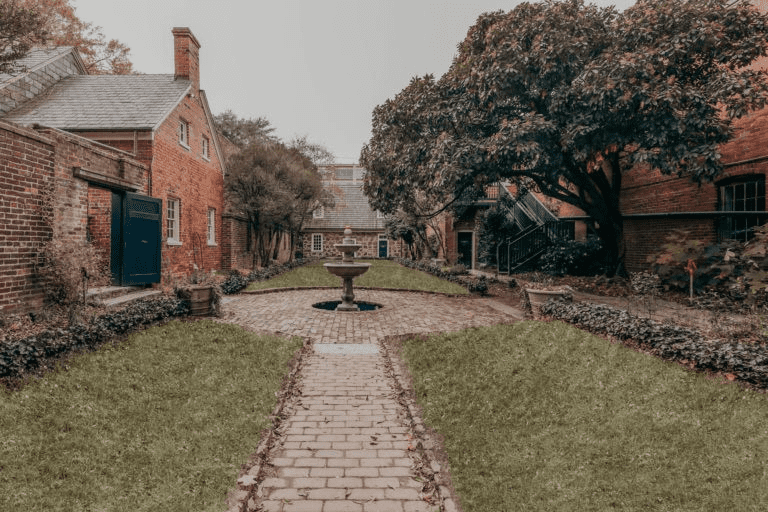
The Enchanted Garden at Richmond’s Poe Museum. Courtesy the Poe Museum.
Lovers of classical music may want to plan an RVA getaway on the weekend of Oct. 11 and 12. Richmond Symphony Music Director Valentina Peleggi conducts “A Night in Vienna” in Dominion Energy Center’s Carpenter Theatre, 600 E. Grace St., that Saturday. On Sunday, the Chamber Music Society of Central Virginia presents a program titled “War and Peace” at St. Mary’s Episcopal Church, 12291 River Road, including Debussy’s “Danse sacrée et danse profane,” Shostakovich’s String Quartet No. 8, a movement from a Ravel piano concerto arranged for flute, harp and strings and a suite from Prokofiev’s “Romeo and Juliet” arranged for flute, harp and viola.
Later that month, on Oct. 25 and 26, Emanuel Ax performs Chopin’s Piano Concerto No. 2 with the Richmond Symphony. Also on the program: Rachmaninoff’s Symphony No. 2 and the intermezzo from Mascagni’s “Cavalleria Rusticana.”

The Valentine, where the exhibition “Fancy: Costumes, Characters and the Richmond Masque” is on view through January. Courtesy the Valentine.
One more festival: the 55th Richmond Oktoberfest takes over the Richmond Raceway Complex’s Old Dominion Building, 600 E. Laburnum Ave., from 6 to 10 p.m. on Friday, Oct. 17, and from 3 to 10 p.m. on Saturday, Oct. 18. Die Lustigen Almdudler (lusty yodelers, more or less) and the Hirschjäger (stag hunter) Bavarian Dancers will entertain. Festival-goers can wash down Usinger’s sausages, red cabbage, potato pancakes, pretzels and baked goods from Reinecker’s of Macedonia, Ohio, with Warsteiner, Paulaner and Bitburger suds, including Oktoberfest styles. Practice your stein hoisting for the contest.
Besides the VMFA, Richmond’s museums include: Virginia Commonwealth University’s Institute for Contemporary Art; the Virginia Museum of History & Culture; the Black History Museum & Cultural Center of Virginia; the Valentine, a city history museum incorporating sculptor Edward Valentine’s studio; the Poe Museum; and the American Civil War Museum.

“Frida Following Amputation of Her Right Leg,” 1953. Lola Álvarez Bravo. Photo by Richard Selden.
The latter, a 2019 merger of the American Civil War Center and the Museum of the Confederacy, comprises two Richmond locations, Historic Tredegar on the James and the White House of the Confederacy close to downtown, and the ACWM–Appomattox. As you are no doubt aware, after several years of study, then the agitation triggered by George Floyd’s murder, the five statues along Monument Avenue glorifying the so-called Lost Cause were removed in 2020 and 2021 (Robert E. Lee).
The city’s fabric of row houses, parks, storefront boutiques, corner restaurants and university and government buildings serves as a pleasant, walkable setting for uncontentious landmarks, notably Main Street Station, served by Amtrak; St. John’s Church, of Patrick Henry fame; and the Virginia State Capitol, designed by Thomas Jefferson.
Honoring the author of the Declaration of Independence is a palatial hotel that rivals or surpasses D.C.’s Willard and St. Regis in historic splendor. Dominating its block, the Jefferson Hotel rises like an off-white mirage at 101 W. Franklin St., resembling a huge Edwardian train station.
Its creator, Lewis Ginter, for whom the city’s botanical garden is named, made several fortunes — in importing, banking, tobacco (the pre-rolled cigarette) and land development — prior to commissioning Carrère and Hastings, later the architects of the New York Public Library, to design an eclectic Beaux-Arts pile that opened in 1895.
After a 1901 fire, the Jefferson was rebuilt, with a ballroom wing added in 1907. Closed from 1980 to 1986, the most recent of several renovations put the guestroom count at 181, including 15 suites.
At the center of the Palm Court lobby — featuring a skylight, Tiffany windows and marble pools where the hotel’s mascot alligators once basked — stands Valentine’s Carrara marble statue of the third president. To the right is Lemaire, a New American restaurant; to the left, a 36-step grand staircase leading to the Rotunda wing of meeting and banquet rooms, framed by two levels of columns, with a skylight 70 feet above.
The only alligator now on property is a life-size bronze statue of Old Pompey, who crawled off to the big swamp in the sky in 1948.


