Culture Capital
By • October 7, 2025 0 789

67 Arts Leaders and Counting: The Georgetowner’s Cultural Leadership Breakfast Series
“To me, this is the most challenging time to be making theater in the country. It’s the absolutely best time. It’s the best place for the expression of important feelings and beliefs,” declared Arena Stage Artistic Director Molly Smith in June of 2019. (If it was true then, think how true it is now.)
Smith, who retired in 2023 after a 25-year tenure, was speaking at The Georgetowner’s 35th Cultural Leadership Breakfast.
On Sept. 16, a drizzly Tuesday, roughly a third of the 67 speakers to date turned out for the series’ 11th anniversary cocktail party at the Kreeger Museum, where they schmoozed among the Monets and Picassos to the sounds of a trio provided by DC Jazz Festival President and CEO Sunny Sumter.
Just a handful of George Town Club members, Georgetowner staffers and arts-minded D.C. residents were present at the creation, on January 27, 2014, when University of Chicago Professor Emeritus Neil Harris spoke about his book, “Cultural Capital: J. Carter Brown, the National Gallery of Art, and the Reinvention of the Museum Experience.” Attendance would have been greater if the National Gallery of Art hadn’t belatedly decided to host the author shortly before his Georgetown appearance.
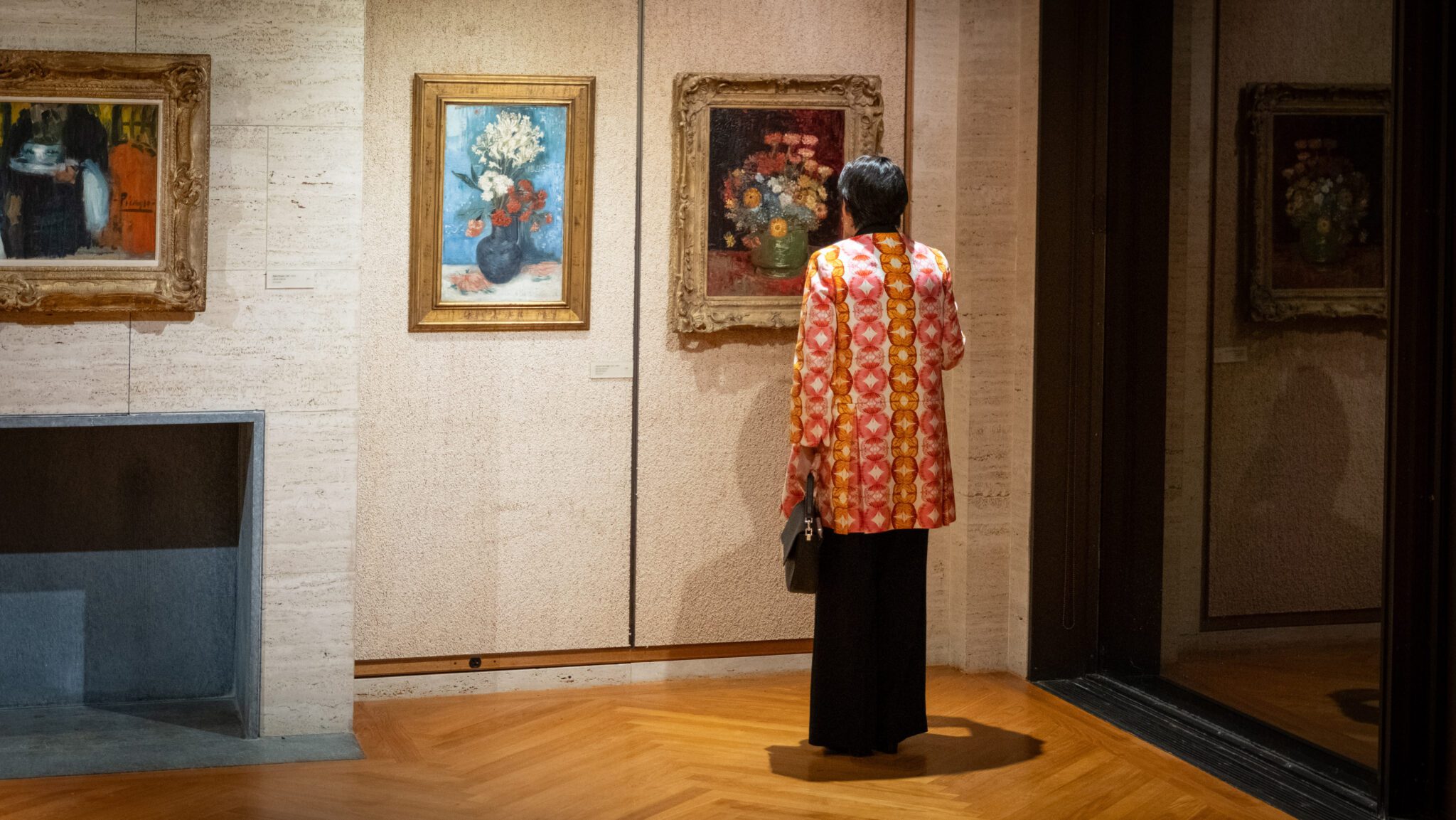
Sixty-four breakfasts, 66 speakers, seven venues (the Capella/Rosewood hotel, Jenn Crovato’s1310 Kitchen, the Tabard Inn, the Four Seasons, Evermay, the Woodrow Wilson House and Dupont Underground), close to 12 years and one pandemic later, it was high time to celebrate the series, thank the speakers and sponsors and relive some of the D.C. arts scene’s ups and downs.
In 1950, when Zelda and Tom Fichandler and Edward Mangum founded Arena Stage, it was the only presenter of its kind in the nation’s capital. There are now nearly 20, about half of which have been represented in the series by one or more of their leaders: Smith’s successor Hana Sharif, Michael Kahn and later Simon Godwin of Shakespeare Theatre Company, Howard Shalwitz and later Maria Goyanes of Woolly Mammoth, Rebecca Medrano and later Gustavo Ott of GALA, Ari Roth after he left Theater J to found Mosaic, Roth’s successors Hayley Finn at Theater J and Reg Douglas at Mosaic, Matthew Gardiner of Signature, Tim Nelson of In Series and Julianne Brienza of Capital Fringe, who noted in 2022 that “so many of the smaller black-box theaters have closed.” She and several of the others, along with 2016 speaker Amy Austin of Theatre Washington, were on hand at the Kreeger party.
From the museum world, the series has featured (in alphabetical order): Melanie Adams, Jonathan Binstock, Gus Casely-Hayford, Melissa Chiu, Aileen Fuchs, Rachel Goslins, Judy Greenberg, Beatrice Gurwitz, Anthea Hartig, Mark Hudson, Peter Jakab, Farah Karim-Cooper, Kathryn Keane, Melanie Mathewes, Julian Raby, Jack Rasmussen, Kim Sajet, John Wetenhall and Michael Witmore, plus gallerists George Hemphill and Victoria Reis.
The dance speakers over the years have been Diane Coburn Bruning, Dana Tai Soon Burgess, Julie Kent, Edwaard Liang, Diana Movius and Septime Webre. Representing music organizations and venues, in addition to Sumter, were Jenny Bilfield, Ryan Brown, Marie Bucoy-Calavan, Christopher Eanes and Steven Fox (a double), Roberta Gasbarre and Greg Lewis (another double), Ángel Gil-Ordóñez, Monica Jeffries Hazangeles, Arvind Manocha, Deborah Rutter, Jace Saplan, Rita Shapiro, Scott Tucker, Martin Wollesen, Doug Yeuell and Francesca Zambello.
Speaking about their multipurpose venues were Yota Batsaki of Dumbarton Oaks, Katey Boerner of Glen Echo Park and Ana Harvey of Dupont Underground. Academics, besides Harris: George Washington University President Steven Knapp, Catholic University Dean Jacqueline Leary-Warsaw and Corcoran School Director Lauren Onkey.
At the party, series organizer Richard Selden shared “a few nuggets and shavings in chronological order” from event write-ups in The Georgetowner by the late Gary Tischler and himself. A sampling follows.
“We don’t have a venue,” noted Washington Performing Arts’ Bilfield in 2014. “That’s significant, and my first reaction, honestly, was relief. What we can do instead is interact with the whole community, its various strands, and venues that we do have, artists, groups, and bring them together.”
From the Washington Ballet’s Webre, soon after he announced his departure in 2016: “I’m really, really proud of what we’ve done here in this city, which, when I got here, didn’t have what you could call a diverse arts community. The city was still a little quiet then, and truth to tell, the food wasn’t much either.”
“The hard question is: Are we overbuilt?” asked Woolly Mammoth’s Shalwitz in 2017. “I don’t mean to be too pessimistic, but I’m getting out at the right time.” Goyanes, his successor, recounted six years later how the last week of a run in February had to be canceled when an actor tested positive for Covid: “In that one moment, we lost upwards of $100,000.”
“Why has Washington lost so many galleries since the time I arrived?” wondered longtime gallerist Hemphill in 2018, offering some possible reasons. The following year, the National Museum of American History’s Hartig quoted James Baldwin: “American history is longer, larger, more various, more beautiful and more terrible that anything anyone has ever said about it.”
In 2022, Nelson of In Series pointed out an advantage of his company’s home city: “The great thing about D.C. audiences is they’re so smart.” Two years later, Dupont Underground’s Harvey said: “Artists come through almost every day. I never say, ‘No.’ I say, ‘Not yet.’” That fall, Signature Theatre’s Gardiner assured breakfast attendees that “theater is not going anywhere.”
The day after the Kreeger party, Boerner sent Selden and Georgetowner Publisher Sonya Bernhardt a thank-you email. The assembled cultural leaders were “an incredible group to bring together last night,” she wrote, adding: “the conversations were really interesting, and I think some collaborations may come out of it.”


