
Bourbon, Brilliance and Bold Moves: How Viyas Sundaram Seizes the Day
By • November 12, 2025 0 853

His Instagram bio reads “Carpe Diem addict.” He certainly seems to have taken to heart Mr. Keating’s “Dead Poets Society” directive to make his life extraordinary.
LoudounNow.com branded Viyas Sundaram, former CEO of Reston-based software firm GoCanvas, a “serial entrepreneur.” And though he’s only 48, “clearly, I’m an old soul, as my wife says.”
On Sept. 26, Sundaram held a coming-out party for the seven- and 14-year releases of 1787 Provenance Straight Bourbon, offered by his and whiskey maker Jay West’s Middleburg Barrel Company, based at Sundaram’s 121-acre estate. The event took place at 1048 Wisconsin Ave. NW — “in my mind a trophy, iconic Georgetown building,” he says — that he acquired from Karen Snyder of Snyder Properties in February for $6.625 million. Formerly the Georgetown home of Patagonia, the 4,900-square-foot building, on the corner of Grace Street by the C&O Canal, had been vacant since the end of 2018.
Just how did this Chicago-born son of immigrant parents, “a diehard Bears fan,” end up dividing his time between Georgetown and Middleburg?
Though it didn’t shake his loyalty to the Windy City, after age 5 Sundaram grew up mainly in Augusta, Georgia. At Emory University, he majored in political science and economics and, thinking he “wanted to be a Gordon Gekko,” interned at Merrill Lynch. Sundaram’s serial entrepreneurship began in his Atlanta dorm room. Partnering with his sophomore advisor, a “really smart IT guy,” he launched a start-up and rode the dot-com boom.
A few years later, in the early 2000s, a sales and marketing position with Mindshift Technologies brought him to Virginia’s flourishing Dulles Technology Corridor. (Sundaram remained with Mindshift after it was sold to Best Buy in 2011. Ricoh acquired it in 2014.) While there, he completed an MBA at the University of Maryland’s Smith School of Business, which he calls “one of the most amazing experiences for me,” crediting it with teaching him to “ask different questions than I was biased to ask.”
His next stop? Senior vice president of sales, then chief revenue officer at Snagajob (acquired by JobGet last year), based in Richmond suburb Glen Allen, from 2014 to 2018.
“I became a turnaround executive,” he says of his career at that stage. But after leaving Snagajob, “I wanted to be with my kids.”
Sundaram and his wife, Jaya Saxena, who is part of Spencer Stuart’s global inclusion team, have two daughters, aged 8 and 12, now at Georgetown Day School. His homebody plan was short-lived, however. In 2021, a private equity firm called to ask if he would consider an operating role, and he took the top spot at GoCanvas, which creates mobile apps and online forms used by field workers in construction and other industries. (The company was acquired last year by the Munich-based Nemetschek Group.)
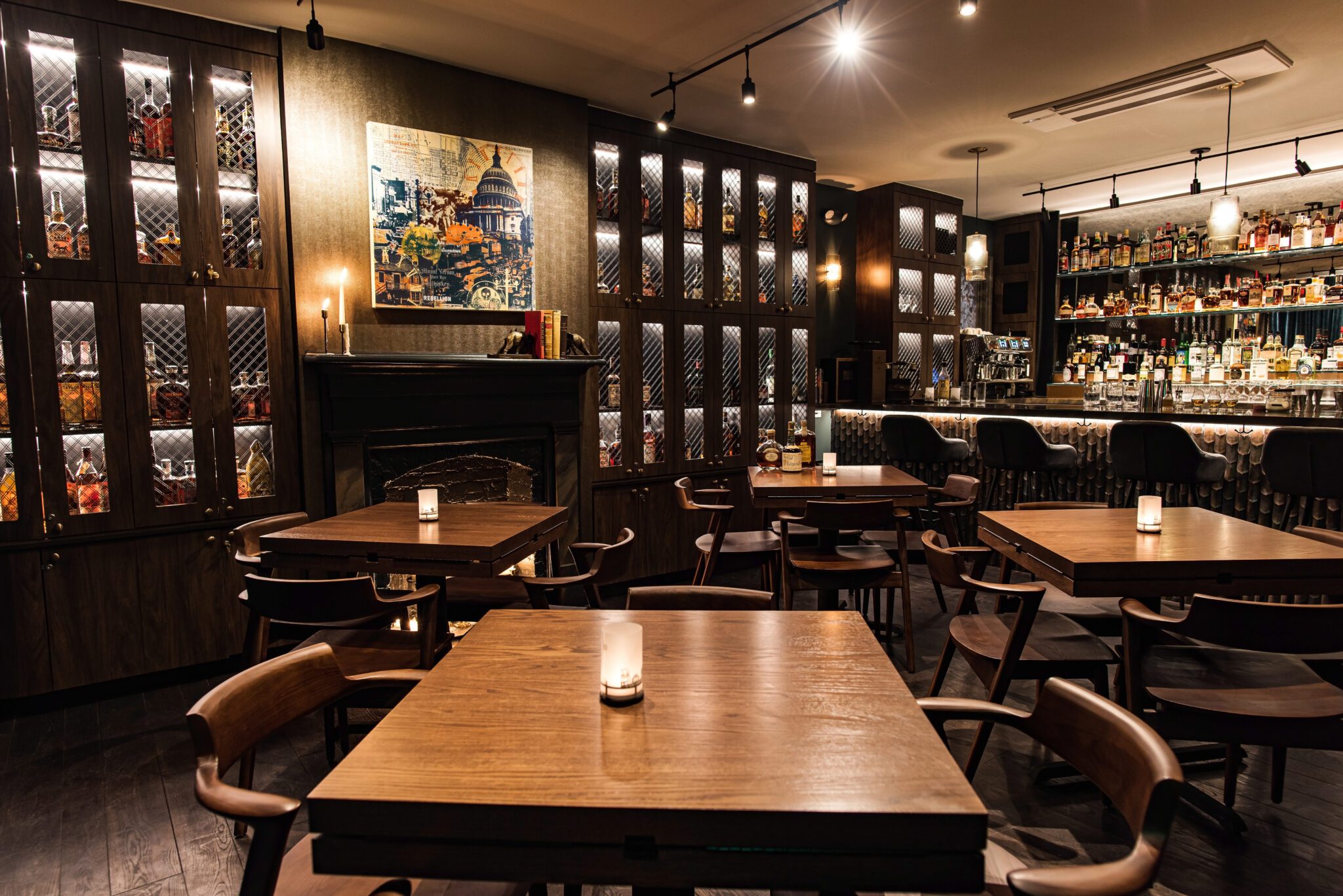
The Fountain Inn Bar Room. Courtesy The Fountain Inn.
Infatuated with History
When Sundaram first came to the Washington, D.C., area, “I was too poor to afford housing,” he (questionably) claims. His solution was to buy an 1890 townhouse at 13th Street and Florida Avenue and bootstrap a gut renovation. When he brought his mother to see it, she was taken aback by the bars on the windows, thinking, he says: “What is my son doing?”
A different kind of shock, a positive one, was ahead for Sundaram, “when I first broke open the drywall and saw the original fireplace … I just became completely infatuated with the history of these buildings.” In 2005, with the building’s renovation complete — and with the help of “borrowed plumbers and electricians” — he moved in. “I was now living in one of my creations,” he says proudly. Two years later, he sold his creation on Craigslist and not only moved out but moved on, purchasing a property every other year.
One of those early real estate investments was a mixed-use building nearby on U Street, occupied by a dental office. Retaining the local business became part of Sundaram’s M.O. If a retail property didn’t have a tenant, he would try to find something good for the “ecosystem,” he explains. While appreciating what M Street’s upscale national chains bring to Georgetown, for example, “what makes Georgetown is the Tuckernucks of this world,” he says, in other words, homegrown businesses that keep growing.
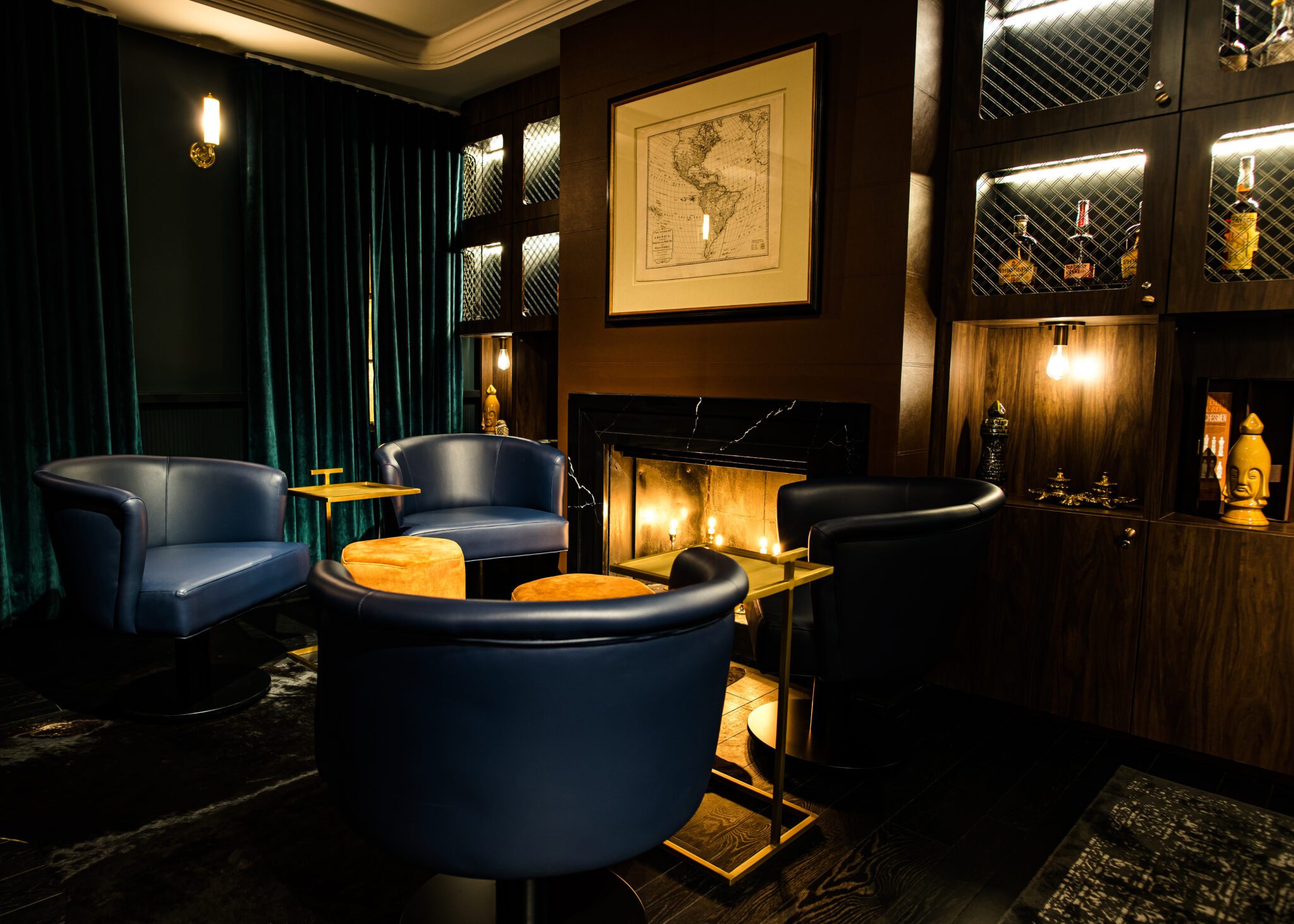
The Fountain Inn by the fireplace. Photo courtesy The Fountain Inn.
A Multisensory Journey
Two decades ago, as Sundaram was getting to know Georgetown, he recalls, “I went on a date to Citronelle,” chef Michel Richard’s culinary destination in the Latham Hotel. Like the drywall moment, it was a transformative experience: watching Richard walk another patron through a “wine journey.” Years later, having begun collecting rare bottles of whiskey, Sundaram started up an online reseller called the Bourbon Concierge — “just a fun passion project,” he says. (Another passion: Ferraris from the 1970s, ’80s and ’90s.)
One thing led to another, as they do with Sundaram. Thinking that “we should create an experiential tasting room,” and devoted to historic preservation, he purchased 1659 Wisconsin Ave. NW, where, in 1783, John Suter established a stagecoach stop and tavern known as the Fountain Inn.
Upon becoming CEO of GoCanvas, however — though “I could still do drop-off at Little Folks,” the Georgetown preschool — Sundaram took a step back from his whiskey projects. But the Bourbon Concierge “just boomed,” and he “let it be its own stand-alone experience.”
Reborn in March of 2022 as “a highbrow tasting room and cocktail bar centered around pours of distilled delicacies from all over the world,” according to Eater DC, the Fountain Inn was an instant hit. A recent accolade: In July, Washington City Paper named chef Greg Heitzig the Best Chef in Washington. To Sundaram — who says, “I just love resurrecting history” — the Fountain Inn is “a place to connect and create a memory,” and tasting “becomes a sort of multisensory journey … you’re pouring the story.”
The following year’s purchase of what was then called Mortgage Hall — an 1850s horse farm just outside Middleburg, once owned by a Sears heiress — was the result of spending time in the area during Covid and, says Sundaram, watching his daughters interact with nature. Following a two-and-a-half-year restoration process, the property became the base for Middleburg Barrel Company, a way to leverage the “barrel picking” experience associated with bourbon, “an American heritage.”

Middleburg Barrel Company. Photo by Krysta Norman Photography.
Renamed Provenance Estate (“provenance” being the art historical term for an object’s ownership history), the former Mortgage Hall is now a venue for private and invitation-only events. “We are big conservation folks,” says Sundaram, meaning that he wants to limit the property’s impact on the landscape. Bourbon purchasers who choose a barrel from among the hundreds in the estate’s rickhouses get the full experience, staying at the manor house and eating chef-prepared meals. “Every barrel has a unique flavor profile,” notes Sundaram. There are also half-barrel and 12-bottle options. Starting next month, on Saturdays only, 12-bottle purchasers can reserve a two-hour visit.
Conscious of the historical significance of the Middleburg-to-Georgetown corridor, traversed by Washington, among others, Sundaram refers to its “amazing town-and-country dynamic.” In the two locations and farther afield, he and his wife are active donors, both through direct giving and via the Sundaram Philanthropy Fund, which supports youth empowerment, the arts, freedom of the press and conservation. Last May, Saxena and Sundaram chaired the Boys & Girls Clubs of Greater Washington’s BlueFest gala, which netted more than $1.2 million.

Aerial view of Mortgage Hall. Photo by Krysta Norman Photography.
In Georgetown, about eight blocks from the Fountain Inn, Sundaram now has an office at 1048 Wisconsin, where the interiors and systems are being restored and modernized. “We’re currently trying to evaluate what the right concept is,” he says. “The intent is to bring some form of experiential retail to that space.” While putting a high value on history, Sundaram leaves no doubt that he will continue to seize the day.


